
WAS OUR SINGER-SONGWRITER A MEMBER OF THE RAINBOW GIRLS?
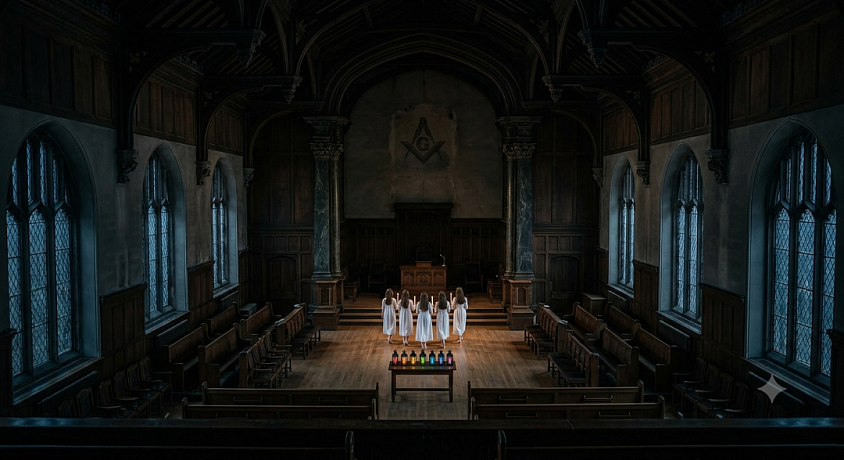
Rainbow Girls -- A Masonic Youth Service Sorority
What are the Rainbow Girls?
Founded in 1922 by W. Mark Sexson, a Christian minister and Freemason, the International Order of the Rainbow for Girls (IORG) was established to provide a structured leadership and character-building framework for young women aged 11 to 20.
Sponsored by local Masonic Lodges and Eastern Star Chapters, Rainbow Girl Assemblies operated across mid-century America -- most particularly in rural regions. Members were trained through ceremonial rituals focusing on the seven core virtues of Love, Religion, Nature, Immortality, Fidelity, Patriotism, and Service.
Each of the seven "virtue stations" features a dedicated pedestal light or "station lantern" -- typically candles enclosed in glass frames. The opening and closing ceremonies require the progressive lighting and extinguishing of these lanterns in exact, unvarying sequence.
The "Lessons of the Seven Degrees" rely heavily on biblical and historical allegories of "safe harbors," "navigating stormy seas," and the civic duty of "rescuing the displaced," the "shipwrecked," and "the lost." Rainbow members are trained to view the organization as a "beacon of stability" against a corrupting outside world.
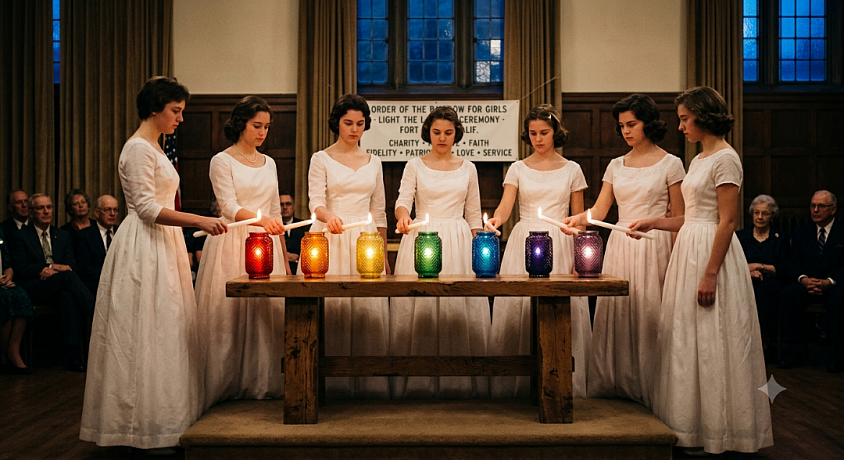
The Seven Station Lanterns of the Core Virtues -- Love, Religion, Nature, Immortality, Fidelity, Patriotism, and Service.
Now that's all a bit spooky, considering that every single metaphor above is found within the Light the Lanterns lyrics. What's more, a light beacon is the archetype of both maritime and human salvation, the very lives that Thomas and Grace Atkinson lived at their light stations and through Freemasonry.
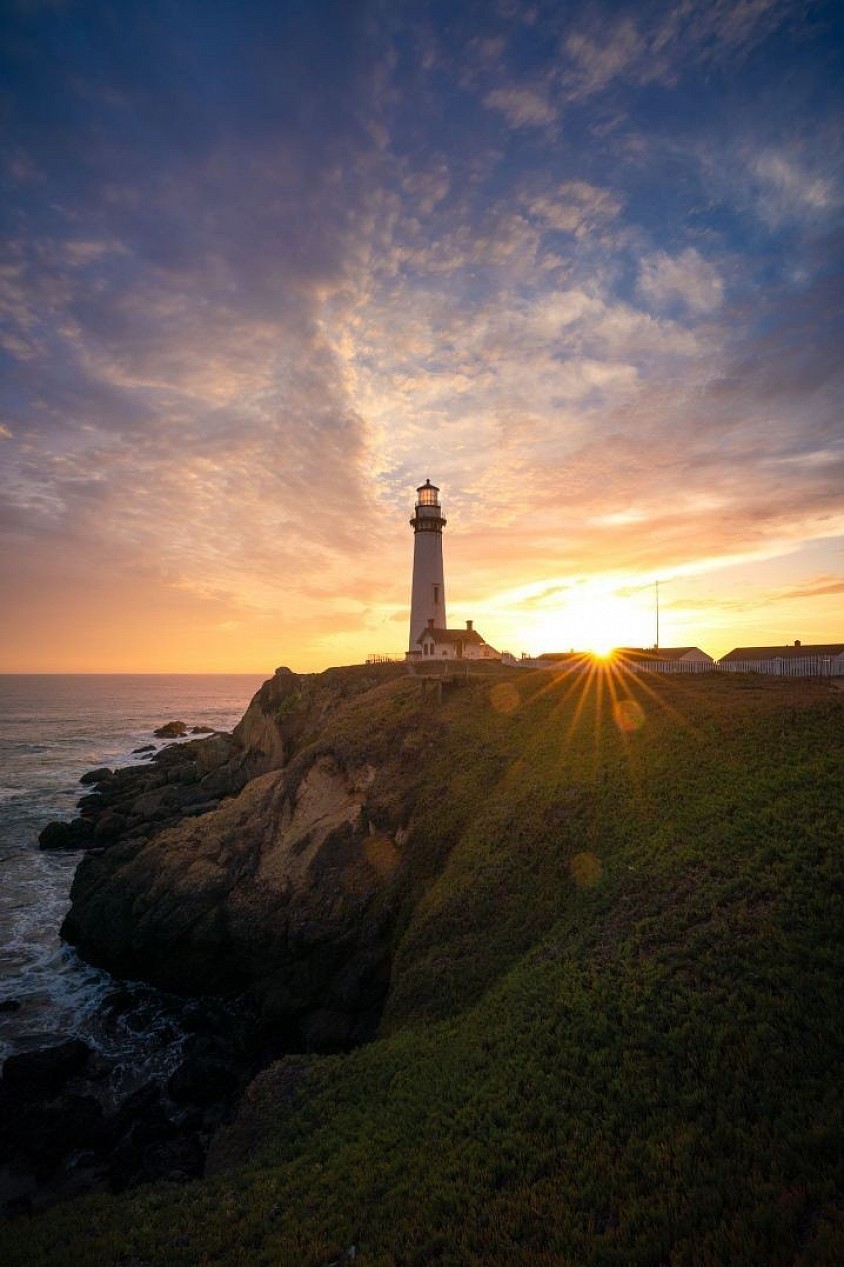
A Beacon - For Sailors and All Those Seeking Light
A Breakthrough Thesis on the Song's Metaphysics and Characters
Thomas Atkinson, the Point Cabrillo Light Keeper from 1939 to 1950, was a Californian Master Freemason. His wife Grace Atkinson was a Matron of the Order of the Eastern Star, from 1939 onwards. And most children of Freemasons were automatically enrolled as Rainbow Girls.
I haven't yet found out if Delpha was a Rainbow Girl while residing at Point Cabrillo from 1939 to 1944 (aged 12–17), but it sure wouldn't surprise me. It might also be that Delpha's two younger sisters, Flora and Mildred, were also Rainbow Girls until they left school in 1947 and 1949 respectively. For a young woman growing up on the rural California coast in the 1950s and 1960s, the Rainbow Girls would have been a primary social and cultural sorority.
Grace's membership in this secret order would have DEEPLY driven her life even outside of the temple. And Delpha's indirect knowledge of it, along with her high probability of being a Rainbow Girl, adds intriguing lantern-lighting elements to our story.
The core philosophies of the Order of Freemasonry, the Order of the Eastern Star, and the Order of Rainbow Girls suggest a profound connection between formal temple teachings and private lantern rituals. In all Masonic philosophy, "The Light" represents divine wisdom and truth, where lighting a lantern signifies dispelling ignorance, refining character under the "all-seeing eye," [the famous Masonic Emblem, the Eye of Providence], and bridging formal chapter ceremonies with practical daily life.
For a Rainbow Girl, lantern-lighting was an integral part of the philosophy and the twice monthly ritual in the local Masonic Temple.
So if our singer was a Rainbow Girl, from say 11–18, she may well have crossed paths with Delpha in the early 1960s to earn herself a trusted invite to "take on the legacy of illumination night." Such a scenario would make perfect symbolic sense: that Grace --the light-keeping matriarch of the Atkinson family beyond Thomas's death -- would accept a referral from her ex-Rainbow daughter Delpha, of a younger Rainbow acquaintance who is in fact our songwriter.
Rainbow Girls Operations
The operations of a Rainbow Girl Assembly are strictly governed by a formal ritual book, with meetings taking place in a closed lodge room arranged around a central altar.
The IORG rituals trained members to memorize pages of text and deliver them clearly, standing unmoving at a lectern before an audience. This environment provided the initiate with disciplined training in memory, vocal projection, diction, and stage presence. Such extracurricular tutoring would certainly have assisted high school grades and leadership roles. It was what most parents would have wanted for their daughters. Such institutional structure would have directly shaped their developmental and creative skill set.
Members were expected to uphold strict, traditional moral codes aligned with the conservative values of the era -- to be "good Christian girls".
The many girls who belonged to IORG in the 1960s, were proud of this pedigree, wearing their symbolic lapel pins to school.
Girls remaining active in the movement until their 20th birthday received their "Majority Degree" and transitioned out of the youth ranks -- possibly to continue on into the adult Order of the Eastern Star, as Grace Atkinson did (and potentially Delpha). However, the natural breakpoint for many girls would have occurred at age 18 with high school graduation and transition into college or jobs.
A Pivotal Period For Our Singer
Armed with the confidence gained from the Rainbow Girl sorority, and a definite simpático for the spirituality of the movement --
- Illumination Night Year 1: Our singer-songwriter happily accompanies Delpha to her first attendance at Grace's dying lantern ceremony: "She took me to illumination night, to pass on a legacy". (Verse 1).
- Year 2: Delpha is inexplicably absent: "She left me with Grace the next year, she went away, I don't know where" . (Verse 2).
- Year 3: The singer maintains her commitment: "I'm going back on illumination night, to see if I can light the lights". (Verse 2).
- But she makes no further mention of her ritual obligation. The great mission to save the precious illumination night abruptly ends within the song's timeframe.
It is clear from the singer's personality traits expressed within the lyrics that she was coming of age from the early to late 60s. She sings at the very beginning: "I was already on the outside, I wanted to be what I wanted to be".
Perhaps, even in her childhood years, before writing the song, she was feeling restricted by family codes, social codes, school codes, even Rainbow Girl codes, and may well have left town soon after the 3rd illumination night for college, the urban musical opportunuties, and all the alternativeness of San Francisco due to her Self-seeking.
While a demo recording of a 1968-69 San Francisco piece of electric folk suggests a distinct shift in attitude from a possible Rainbow Girl culture of prior years, the song retains the deep, respectful, and spiritual elements of her Rainbow Girl upbringing. LTL was not "protest folk" or "proto-punk".
The Merging of History and Metaphor
In writing her cryptic, historically true AND metaphorical lyrics, our singer did not need to invent a fantasy. She repurposed the literal and spiritual ideals of her youth. She merged the legacy of Grace's rescue lanterns into something more universal. The Rainbow Girl altar lanterns married perfectly with Grace's symbols of the Farallons coastal search lanterns. The institutional focus was stripped of its Masonic context and presented through the lens of individual survival, all throughout carrying the threads of hope and spiritual salvation.
I perveive that our singer has cleverly mixed the vocabulary she learned through the Rainbow Girls to write a coded departure piece from her local region, ensuring that the local characters back home could not easily identify her or themselves were her song to ever be recorded and released.
Songwriting for Posterity
It can be said that musical artists often try to manifest their immortality, or at least the immortality of universal ideas, into songs that carry on beyond them. Folk songs have been achieving this for millennia. Popular songs do the same but with more mundane themes.
But Light the Lanterns carries a far more universal theme, epitomised in its repeated chorus line -- "Light the Lanterns Everyone, and Pray that the Rain Won't Come".
While this hypothesis remains circumstantial conjecture, it neatly stitches together several historical and psychological elements into the tapestry of the song, giving us a much tighter focus for our search within the region and culture of those times.
Conclusion
Investigating this Rainbow Girls thesis is but another little piece of the big jigsaw puzzle called Find The Singer. Way back in the beginning of my research, I hypothesized that to find our singer we only had to follow Delpha -- the "She" in the story. And again, it appears from what may be a Rainbow Girls connection between them, that Delpha may well lead us to the woman she took to her first illumination night -- our mystery singer.
