
INSTRUMENTAL BREAKDOWN
Introduction
My investigations into the instrumentation and players of the original LTL recording are intended to narrow down the date, place, and style of the song, whilst debunking the many false speculations about the band’s instruments and identity.
To do this we must work from the only musical evidence we have: a mid-80s discovered cassette. We must therefore use forensic musicality rather than guesswork.
The Process of Analysis
I sent the cleanest available YouTube version of LTL to three different recording engineers (in Australia, LA, and Houston). I intentionally selected professionals in their 50s and 60s for their broad musical and historical knowledge. All are accomplished guitarists, and one is a respected luthier. They were engaged to:
- Conduct track and instrument separation using the latest AI software;
- Identify every possible instrument on the recording;
- Suggest the track-count used to compile the master tape;
- Assess production effects, player expertise, and the probable era of the recording session.
- These technicians hear details that amateurs miss. I have combined their analysis with my own 60 years of experience in semi-professional folk and pop performance, including some recording work, roadie work, and managing bands.
Modern Audio Changes to the Original
Over the six years LTL has been online, various people have attempted what they call "remastering." True remastering requires the original master stems -- so these bedroom improvements are not that. They are not even re-mixing. All the modern "improvement" efforts are simply well-meaning bandpass filtering to "clean up" a degraded, mono cassette. By accentuating certain frequencies, these amateur filters often create "psycho-acoustic illusions" -- that means producing sound effects that weren't on the original tape or in the original room. This has led to total confusion regarding what instruments are actually present.
"Musicfan1994" thoughtfully wrote below one such modification:
"The reverb you put on this recording effectively makes this unsolvable. When musicians and people in general listen to a recording of a song they normally listen to every element of the piece, and just assume that everything in the recording should be there. They will tend not to distinguish between what should be there and what shouldn't (aside from using common sense) nor block out elements not typical of the genre the music fits into/what they think shouldn't be there/what they think they shouldn't be hearing. This includes reverb. If you send people the original upload from Windows To Sky (in this case a reupload because the original video was privated), they may be able to help you better, and we may get a solution quicker. Until then, we won't be able to solve this, unless you tell anyone you send this particular recording to that the reverb is not part of the song, in which case they will bear that in mind when listening".
Most amateur listeners can identify the primary female vocal, intermittent harmony, rhythm guitar, slide lead, bass, drums, and occasional tambourine within Light the Lanterns. However, over the years, others have postulated imaginary keyboards, a synthesiser, drum machines, or 12-string guitars. My professionals have now provided a definitive mix. Their assessment of the original instrumentation follows:
* * * * * * * * * * * * * * * * * * * *
Definitive Instrumentation
* * * * * * * * * * * * * * * * * * * *
Primary and Backing Vocals
Overall, this girl's voice is satisfactory but not outstanding. She does not have any standout tones or vocal range. If she was "a belter" or a natural soprano or had a lovely warble vibrato, she would have shown those skills on a demo for the recording industry. But her rather flat, mid-range presence without much high-end "sparkle" in the EQ is typical of late-60s dynamic mics like the Shure SM58. It is certainly not late 70s or 1980s voice processing.
No talent scout would listen to the singing in Light the Lanterns and think, "Hell yeah. I could make a star out of that girl". This is the underlying mindset towards every demo tape: "Can our company make a lot of money out of investing a little money on this unknown artist? Has she got a bankable X-factor?" The short answer from the LTL Demo is clearly no.
The weak and fluctuating vocal harmonies in the original were undoubtedly the primary female singer too. Her higher range harmonies are very background, unsure of themselves, intended only for tonal colour rather than performance. She starts a harmony line then drops it because she gets lost in unresolved phrasing. She certainly had not spent much time rehearsing vocals as you would with a second vocalist to get harmonies tight. If a second singer were any good, they would be featured much more. This was not a two-girl band, as it would make no recording sense to invite another singer for this session just to add so little, so poorly. Note: In the new 2025 Remastered Version, we have added beautiful new overdub harmonies to emulate what the second voice could have done for the song. It truly uplifts the harmonies to what they should have been.
Rhythm Guitar
Agreement was found to be a six-steel-string -- possibly a semi-acoustic, but most likely a full-body acoustic guitar recorded with close-in microphone. It is definitely not a solid body they all said. Everyone agreed it is not a 12 string, as myself and some others had once suggested. The strumming accompaniment seemed linked to the singer's own vocalisation rhythm, suggesting the songwriting was hers. It’s fairly easy to tell when a singer "owns" her own song; the rhythm guitar provides the solid folk foundation, which then allows the lead guitarist the space to layer on those "trippy" atmospheric swells that define the song's texture. Session musos and visiting players are always very aware of not taking over the songwriter's song.
The rhythm guitar was standard tuning, E-A-D-G-B-E. She was playing all open chords. Key of D major, or A if you consider it Mixolydian. No bar chords. All strumming, no finger picking. No syncopation, no strum dampening. That is a typical folky style for a female on a wide-necked acoustic guitar. You don't usually play open chords on thin-necked electric guitars nor barre chords on a wide-necked acoustic folk guitar.
I wish we could better narrow down the exact instrument. In that era, the Martin D-18, D-28, and D-35 were the classic workhorses of the late 60s, ranging from $300 to $450. While luminaries like Dylan and Mitchell used the luxurious D-45 ($1,200), it is highly likely our player was using one of the more affordable, standard models used by nearly every folk amateur of the late 60s.
Guitar and Chordal Structure
For the most solid evidence of late 1960s songwriting, see the Page 12 - RESEARCH ARCHIVE - Timeline Analysis of Guitar Chords.
Lead Guitar
Different opinions arose between the experts here. It may be a semi-acoustic or a solid body. Humbucker pickups were suspected into a guitar amp, which was then miked to the recording mixer. Humbucker pickups sound warm, thick, and powerful, with more bass and mids and a "fatter," more compressed tone compared to the brighter, sharper sound of single-coil pickups. I keep thinking of a Gibson ES series: the 335, 345, or 355, which many popular electric folk players used.
A swell or volume pedal was used to accentuate the slide tonality. These were quite popular in the 60s. The swell is what makes it sound rather "trippy" and also makes the notes sound bowed like strings. This is what has tricked some listeners into hearing sythesisers which aren't there.
Bass Guitar
Here it gets interesting. I uploaded the bass track to several bass forums, posing the question: "Is that a fretless or not?" The consensus was about 80/20 in favour of it being fretless. Most said "definitely yes." A few said "probably, but not necessarily," proposing that a really good player with flat wound strings on a fretted bass could feasibly sound fretless.
My three technicians were a definite "yes." But the clincher came from a famous and respected fretless bass guitar repairer, working in Burbank LA for 21 years who, after I sent him the separated bass track, emailed me as follows:
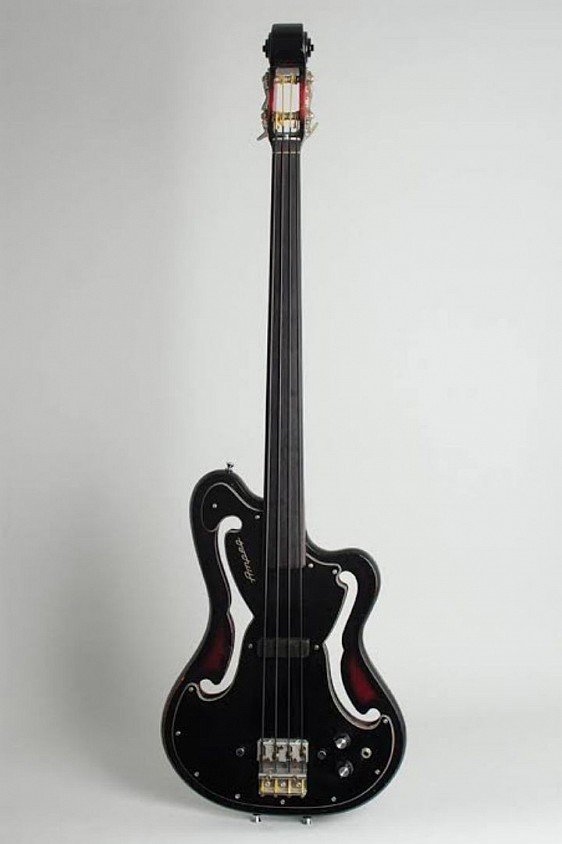
The Famous 1965-1970 Ampeg Fretless Bass with Scroll Head -- just like the double basses of the times. The first commercial fretless.
"I can confirm that track sure sounds like the fretless Ampeg AUB-1. They were made from September 1966 through late 1968. The original AUB-1 has a unique type of pickup that no other bass of that time had. It detects the movement of the whole bridge, rather than the individual strings. The sound has a very percussive attack curve with a noticeable pop and warble. And the mid-range is exceptionally rich with background colouration. But it's not mushy, like a Fender with tapewounds. It's possible to get close to that sound with a Fender, with some good musician skill and recording technique. But my guess is that this is the real thing, somebody playing their cool new late 60s Ampeg AUB-1, and probably through an Ampeg B-15 amp." Bruce Johnson, Renowned Ampeg Historian, Rebuilder and Luthier.
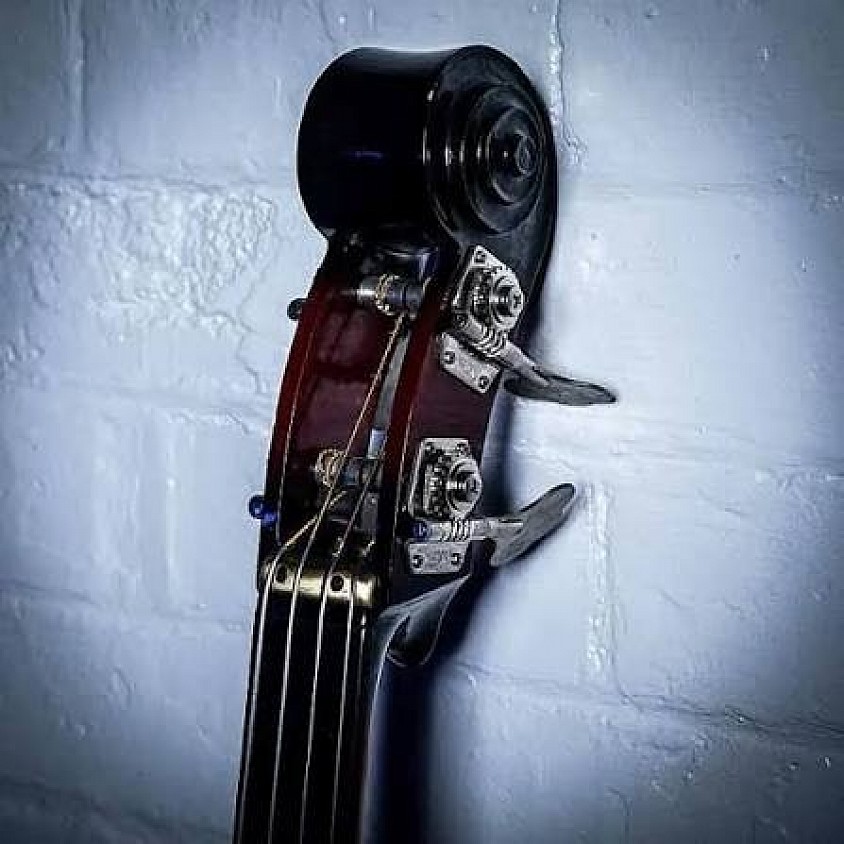
The Famous AMPEG Fretless Scroll Head Bass. 1966-1968. The very first shop-produced fretless.
So there we have it—an experienced ear identifying the exact model and year of the fretless bass. Sure, it could be a later recording on earlier instruments, but more implications about that are discussed following.
One elderly bassist of that era pointed out to me that many early fretless bassists probably came across into pop and rock from playing an upright bass in orchestral, jazz, or trad-folk genres. An amplified upright bass was a common crossover thing for early electric folk in the 60s, as per the well known Seekers. Their stereotypical folk-pop crossover repertoire of that era sustained a perfectly good driving rhythm and melody with only upright bass, rhythm and lead acoustic guitars, four vocals, and frequent tambourine by the female singer.
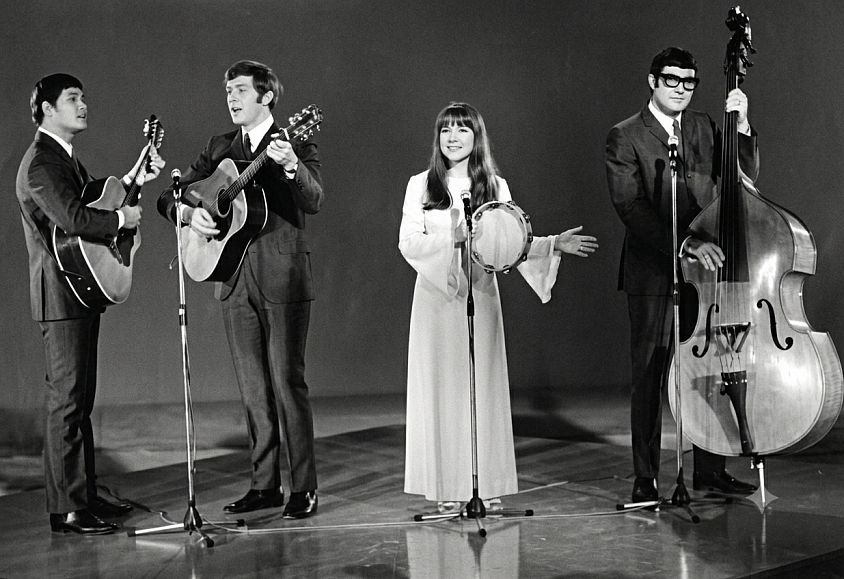
The Seekers, 1964-1968. Stereotypical folk-pop crossover band of that era.
The absence of drums wasn't an issue because their music didn't need it -- exactly like LTL. The next evolution into folk-rock was the transformation into electric bass, electric guitars, and a two- to three piece drum kit.
This is precisely why the Ampeg AUB-1 was engineered; it was specifically designed to bridge the gap between a traditional upright and a modern electric. That's why the early Ampegs had a scrolled headpiece ... a nod to the hand-carved orchestral basses and cellos of the last few centuries.
It is clear from the bass playing in LTL that he was no virtuoso fretless player like others of the time and later. He's moderately competent, moderately melodic, but no Rick Danko, Jack Bruce or Jaco Pastorius!
Contemporary Early Fretless Icons
It's worth noting the famous fretless players of the times, some of them on this specific instrument:
- Rick Danko of The Band, who made their concert debut in San Francisco at Winterland Ballroom in April 1969. He played an AUB-1.
- Walter Becker (Steely Dan) played Ampeg basses in the late 1960s, including a 1968 Ampeg AUB-1 fretless.
- Rod Hicks (Butterfield Blues Band) used an Ampeg AUB-1 at Woodstock 1969.
- Daniel "Freebo" Freeberg, (b.1941) famous LA bassist, singer-songwriter, active since 1960. Reputedly played fretless but no references to him playing an Ampeg in that era could be found.
- Phil Lesh of Grateful Dead played Alembic fretless around SF in that era, but not an Ampeg.
I am not suggesting that any of these players are the LTL player, but it is highly likely our LTL bassist was inspired by some of these contemporary bass heroes who were using the AUB-1 at the time.
Our LTL bassist remains a rare bird among the mostly non-fretless bass players of the time. He stands out as the most creative in this group. His ear is good, and his licks are really appropriate.
Drums
On my first listen, I thought -- What's with that drummer? Sounds like he's asleep, or some remnant from the 1950s, or maybe just a teenage beginner.
Amazingly, there is only a snare drum and a kick drum. There is NO high-hat, NO toms, and NO riding or crash cymbals, no drum fills at all. Nothing but "boom-tuck, boom-tuck" all the way through. Maybe he only had one leg and one arm. It may also have been someone else in the band who wasn't really a drummer but paid to just tap out a time beat in the first take.
The question needs to be asked: why such a basic drum kit? Possible answers:
- too big for daddy's garage or the student dorm;
- the drummer only owned a small kit to carry around and set up in small folk venues;
- the songwriter didn't want a big rock sound;
- or the drummer was only proficient with snare and bass.
Even Ringo had a bigger kit in 1957! And to those who think that Light the Lanterns is a 70s or 80s song, I ask, who on earth would record with just a two-piece drum kit?
The drummer is clearly following the songwriter's guitar rhythm rather than laying down a tempo to guide the song. He's basically just "filling in," keeping everyone in time (sort of) with little sympathetic connection to the bassist. They were certainly NOT playing like a "rhythm section", but then 60s folk was not like that. Drum-work was never the focus. This drumming was a sign of musical immaturity, which perfectly suits a simple folk-pop ballad like LTL and the softer rock of the times.
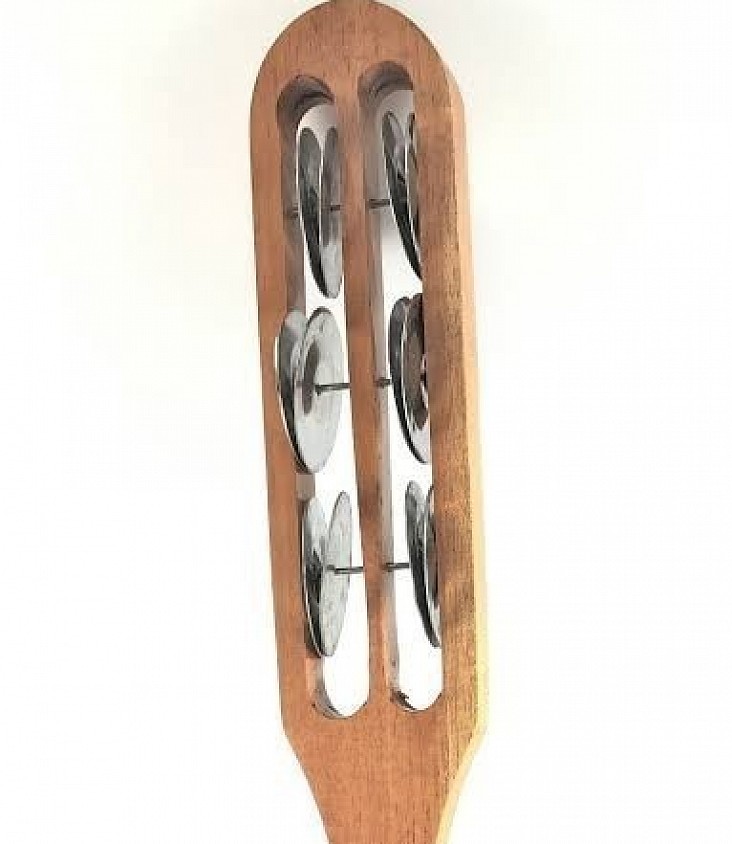
The ever-popular 60s Jiggle Stick
Tambourine or Jiggle Stick
There is an intermittent tambourine, played by someone who seems to move toward and away from a room microphone -- a clear hallmark of either a budget recording studio who didn't really care about such a minor noise on a demo tape or a home recording where nobody bothered about it. No truly professional studio would ever let such inconsistent mic-placement go to master. It was likely the singer or a bystander contributing in the background during overdubs.
But rather than a standard round tambourine, the thin tone suggests an Indian-style "jiggle-stick" (straight tambourine), which was highly popular in late-60s folk circles.
* * * * * * * * * * * * * * * * * * * * * *
Imaginary Instrumentation
* * * * * * * * * * * * * * * * * * * * * *
And here we need to dispel a few more musical myths about Light the Lanterns. Over the years many listeners have put in their two-cents worth about what they can hear in the song. It's hard sometimes to know on social media if people are just terrible listeners or if they are intentionally trolling those of us with better musical discernment. But often a thought-bubble suggestion gets picked up by others and the myths propagate into popular truth. Here are the worst of the batch for Light the Lanterns. These are not just my opinions. They are professionally-analysed sonic evidence.
1. No Drum Machine. It is definitely a human playing, not any drum machine -- as some have speculated. This was proven by measuring the whole tempo of the song against a "click track." The beat occasionally wavers, contrary to a drum machine's perfect mathematical beat. No matter how perfectly humans may think they play, they are never perfectly on the beat all through a song. That's what gives human music its real-feel.
One commenter posited that he was sure it was a LinnDrum LM-1 ($4,995 when they first came out in 1980). There was disagreement with another fantasist for a Yamaha RX-11 ($900 in 1984). It is laughable that LTL would have had such an instrument. The guy on real drums was probably paid $25 for his 3 minutes 10 seconds of work. Another clear contemporary discrepancy is the absence in the drum stem of the ubiquitous 80s gated snare delay and reverb, only introduced post-1980.
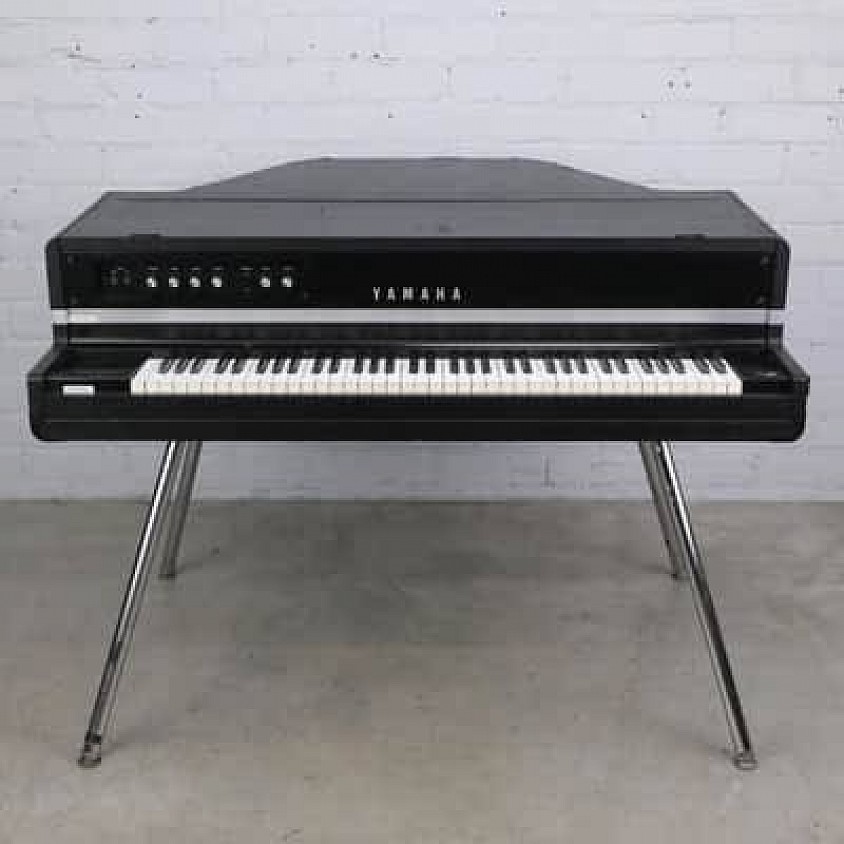
The Imaginary Yamaha CP-80. 1976 onwards. Oh my! A real piano! And all that size and cost for a sound which really isn't there!
2. No Piano. Years ago, a single individual claimed: "I can hear a Yamaha CP-80 in there. I know, cos I've got one." This delusion still persists all over the web, leading others to prattle on about "the keyboards in LTL" to justify their further delusion that Light the Lanterns must have been recorded post-1976.
For God's sake, the CP-80 was a baby electric grand piano weighing 170lbs with a cast iron frame. Imported from Japan, it cost a fortune in its day. It requires two roadies to carry in and set up with 15 minutes of assembly. It is seriously laughable to imagine it was brought in, set up, and recorded into Light the Lanterns for an ambiguous background sound that is not discernible (because it really isn't there)! Please Watch This Assembly Video and see if you can imagine such a professional concert instrument being used in a three-minute ten-second pop song about a spooky island and a dying lantern ritual! And that's apart from no-one else ever hearing a Yamaha piano within the mix. Yet people keep repeating this.
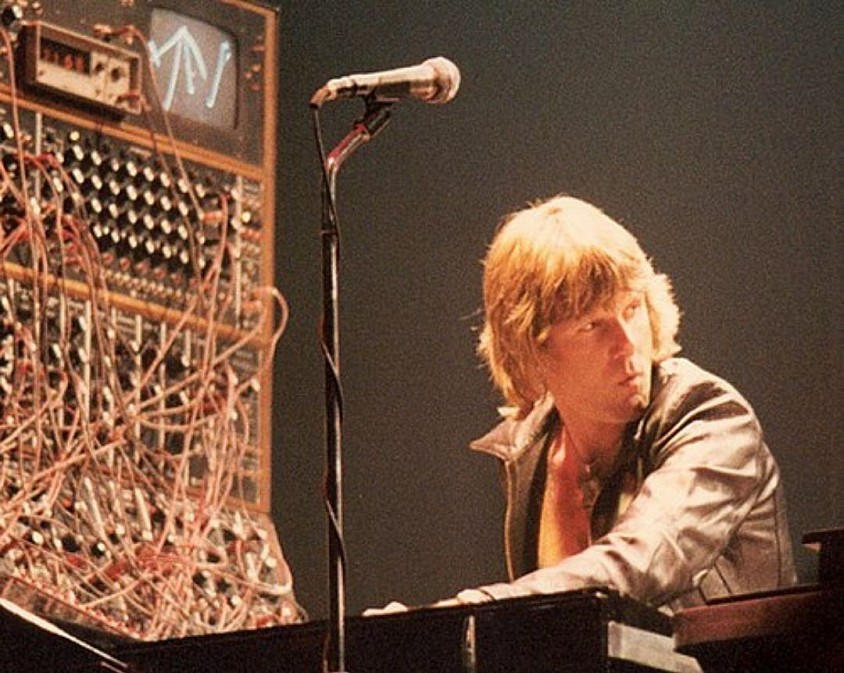
Keith Emerson - The Maestro. His 1970 Monster Moog. The 1970 Mini Moog was $2000, owned by 28 people in the USA.
3. No Synthesiser. Deep audio analysis indicated that the wavy, string-like sound was a byproduct of tape wow and flutter, the slide guitarist's swell pedal, and overtones between the rhythm and slide guitars. Yes, it sounded like strings, but anyone who has ever used a guitar volume pedal could never make that mistake. All three guitar-playing sound engineers agreed: There is no synthesizer in the Light the Lanterns recording.
Furthermore, late-60s pop-folk would never have included a synthesizer. The Moogs and ARPs of that era were monophonic (one note at a time), producing sci-fi sounds more suited to acid-pop and bubblegum-pop. They were the size of upright pianos and prohibitively expensive. Synthesisers were first popular with progressive rock and jazz musicians and found wide use in disco, pop, rock and electronic music. Smaller, polyphonic (multi note, chord-playing) string synths did not exist until 1979–1983 and cost $5,000. This chronology precludes their use on this. In short, no self respecting electric folkie would bring such a synthetic sound into a ballad like Light the Lanterns.
4. No mandolin or dulcimer -- regardless of what certain webpages claim. There are a couple of bars where a high-stringed plucking fill is noticed. But upon more detailed breakdown, these turned out to be little guitar fills high up on the neck, poorly levelled in the mix such that they came and went to be barely perceptible. No musician brings some minority instrument into a studio to put down a few tinkle-winkles a couple of times at the end of a chorus. It was the guitarist just adding a bit of treble brightness where it needed it.
* * * * * * * * * * * * * * * * * * * * *
Summary of Instruments and Players
* * * * * * * * * * * * * * * * * * * * * *
When combined, each of the above assessments give an overall picture of the band as an ad-hoc ensemble of amateur or maybe semi-professional musos, keeping it cheap and simple for a one-off demo tape. I used to think it might have been a budget studio recording with some cheap session players behind the solo singer/songwriter. But the professional studio engineers who have broken down this tape all think not. The playing is far from advanced and the technical aspects -- including obvious microphone bleed between instruments -- are all too amateurish.
I've long had a picture of some college kids who maybe played weekend gigs around the folk clubs. They would have played covers of all their fave bands of that era, as I did in my teens.
I find it hard to believe that an average singer, with an innovative fretless bassist, a very competent lead guitarist, and a sleepy two-piece drummer, were actually "a band". I'm more of the opinion that the singer/songwriter roped in some muso friends to help record her self-promoting demo tape.
When assessing any demo, a talent scout would assess the whole sum of the band for commercial feasibility, as well as look out for any individual member who might jump out of the mix. He might say the band has great potential as a collective entity, or as backing for the front "Star". Or, exactly like Simon Cowell does on America's Got Talent, he might say that one member has great potential but the others are holding him/her back.
So did the LTL band as a whole, or any specific player, have big standout potential? Hard to say about the bassist and guitarist. Their skills may well have developed into the 70s and it's possible that they eventually had bigger careers in the music industry. In my opinion, the singer/songwriter had hopes for a solo career, and that LTL was her first and last shot at it.
Tracking Down Players and Singer
But what happened to them all?
They may each have continued playing little gigs as semi-professionals until a career change. They may have "done the clubs and bars". In the 70s, I knew dozens of "Friday and Saturday Night Wine Bar Musos" who ended up in far better paying day jobs! They would play with some friends for a few months then "the band" would remake itself. This went on till the duds dropped out or the talented ones made notoriety. The one who wanted stardom the most, and who had more talent than their backers, always ended up calling their players - The Jenny Jones Band.
In the 80s, after my musical peers grew out of our 20s, I knew dozens of people who could say "I used to be in a band"! That is what makes the LTL singer, songwriter and players so hard to trace. They never had a music career. They never got onto radio, MTV, or Google! Band membership was a revolving door of talent and poverty! From 1981, MTV became the arbiter of fame through video clips. The gap between pop fame and obscurity widened enormously.
Maybe innumerable rejections of her LTL demo caused her retirement from music as she realised she was not good enough for pop fodder for the record companies. Maybe motherhood took her into domesticity. Maybe the changing musical genres of the West Coast 70s just weren't her style. A song like LTL was totally out of West Coast vogue by 1970/71. The move away from moderate folky-pop towards 70s arena rock and 80s TV shock-visuals explains why this specific sound became a "lost" genre.
The other players might have gigged around for years in clubs and pubs just for casual fun, never desiring to get involved with the sordid, rip-off music industry, then retired from playing music ... or maybe not! It's probably not odd that -- if they are still alive today -- they'd be aware of the LTL search. Who would care about some 50-year-old demo tape you made in college days. That's why a radio campaign for LTL might expose them. Surely, some living bassist must remember this innovative player of the time with his uniquely crafted scroll-head Ampeg AUB-1.
The logic seems clear that this "band" or its front-singer didn't ever go on to later record some other material we might find online now, yet somehow neglect this great demo song for 50 years. And hence the search for this song or this singer in internet archives is, and has been for six years, totally fruitless.
But I don't think the path is completely dead yet. But I am convinced we have to look OFF THE INTERNET -- in the memories of those who were actually there.
I have previously written that the search must go local, to real people in northern California, LA and SF. Sure, the originals may well have died or moved out of town in the interim. In my opinion, finding witnesses OF THAT TIME, to the folk club performances of this song would be one key. But if they never played Light the Lanterns live as a band, and it was just a one-day, come-together-session, in some budget studio, then we only have four or five people in the world who witnessed that day!
