
SONGWRITING BREAKDOWN
* * * * * * * * * * * * * * * * * *
The Songwriting: A Window into Time and Place
* * * * * * * * * * * * * * * * * *
NOTE: This page is not an analysis of the story within the lyrics.
For that see Page 4 - "Decoding the Lyrics".
This page is about the musicality of the songwriting.
Introduction
Analysing the LTL songwriting has helped our search greatly in pointing to the correct time and place of the song's origins. And it has helped to rule out many of the wild guesses that people have been making about the song over the years.
Good songwriting is an art and a science. The greatest songs combine both technical craft with a lyrical relevance that makes them attractive and memorable. The fact that so many LTL lovers connected with the song tells us that it resonated with many people on many levels. Despite the amateur production, the melody itself has that quality of an enduring hook. Once you hear that chorus, it loops in your head for days. That is the mark of a naturally gifted, if unpolished, songwriter. And the lyrics were a bit "odd", enigmatic -- leaving you not knowing exactly what it was about.
LTL is a short musical journey where the chords modulate to capture the emotions of a mysterious, haunting tragedy. It certainly has a catchy chorus, as many have commented. The trippy slide guitar and its one deep plunging minor chord underlines the tragedy of the story. Many say it is spooky, dreamy. Its given name, Light The Lanterns, is perfect as the hook line, the call to action, and as the title.
General Structure of LTL
The song follows a classic folk-pop format of the late 60s. It's pretty formulaic for a potential radio hit: 3 mins 10 seconds. Intro 8 bars, Verse 14 bars, Chorus 14, Bridge 14, Chorus 14, Lead break 8, Chorus 14, Outro 4 bars.
However, unlike 80s pop, which is slave to the 8-bar "grid"
(required for primitive sequencers and drum machines),
LTL uses organic 14-bar phrasing.
This "irregularity" is a hallmark of late-60s human songwriting.
To suggest this song was designed in the 80s
is to admit you don't know how a metronome works.
It was unarguably written before the 70s pattern of 8 and 16 bar turnarounds.
Unusually, there is only one formal verse and, with the bridge and chorus, it tells a minimalist, cryptic, 3 part story. It seems to be written to be loved for the melody, the lilting feel, and the message of times past. The transition from the major-key verses into the minor-tone of the chorus creates an emotional dive which gives the song its yearning, spooky quality.
This was clearly a singles-pitch for airplay. Radio stations dislike fade-out songs. LTL has a fixed ending -- not a repetitive fade out like you might get on an album track or a truly commercial hit with a final hook line which begs to just go on and on in the listener's mind after the song has finished.
However, I doubt that the story content, complexity of moods, or 14-bar form of the song would have impressed the commercial hit-hunters of the day. It's kind of "a bit weird". It's not generic enough for pop -- not happy enough for dancing, not sad enough for tears!
Guitar and Chordal Structure
For the most solid evidence of late 1960s songwriting, see the Page 12 - RESEARCH ARCHIVE - Timeline Analysis of Guitar Chords.
Roots and Influences
Let us reflect on its roots. The early and mid 60s folk genre had of course Bob Dylan, Leonard Cohen, Joan Baez, Pete Seeger, Donovan, Judy Collins, and many others with their folk ballads about social injustices, anti-establishment, anti-war, or bumming around the country. They were strummed-out on acoustic guitar with a haunting voice, written for their MESSAGE and MELODY. Any novice could strum the chords ... as I did. The accompaniment was secondary, if there at all. Dylan was acoustic and a soloist up until 1965, when he and others pioneered the US era of Electric-Folk, aka Folk-Rock. The song's message was still primary, but its electrification made it more poppy, bordering into rock.
Early and mid 60s folk was predominantly a soloist with a message.
Light the Lanterns is at the tail-end of that style,
when electric instruments were brought in to accompany the singer and their message.
Yes, there were also the feel-good groups, "nice" groups, with female voices and lovely harmonies like The Mamas and the Papas, Peter Paul and Mary, The Seekers, The Association, The Beach Boys, and The Beatles of course.
The later 60s was a crossover time. Hence 1965 to 1972 is called the Electric Folk Era. Dylan, The Byrds, Simon & Garfunkel, Buffalo Springfield pioneered it. Many others followed in that style. LTL is clearly a contemporary derivative of that.
LTL is not, for example, your stereotypical 3-minute 3-chord, pop song of the early to mid 60s, with banal lyrics about a boy and a girl, Surfin' USA, fast cars, or Beatlemania. It's not such purist folk as Dylan or Baez 1964. It is derivative of that folk genre, but with later pop overtones.
Another aspect of compoing and recording is that any songwriter and band consciously choose their style, based on styles they like, as well as subconsciously recycling past influences they have absorbed through their own musical growth. So we can ask "Who do the LTL band sound like before them?" For example, a song might be a carbon copy of some former style. Or it may be a hybrid of styles. Or it may be wholly innovative and original. LTL clearly falls somewhere in the middle category.
The Intended Audience
An important aspect to writing and performing, especially for some "Demo", is the intended audience. Any songwriter hopes the lyrics and sound will capture the zeitgeist of time and place. You don't write a song few people might like or relate to ... unless you're already a famous maverick! The songwriter knows that any demo has to make it through the industry "gatekeepers". Clearly it seems LTL did not.
* * * * * * * * * * * * * * * * * * * * *
Music Genres - 1960s and Beyond
* * * * * * * * * * * * * * * * * * * * * *
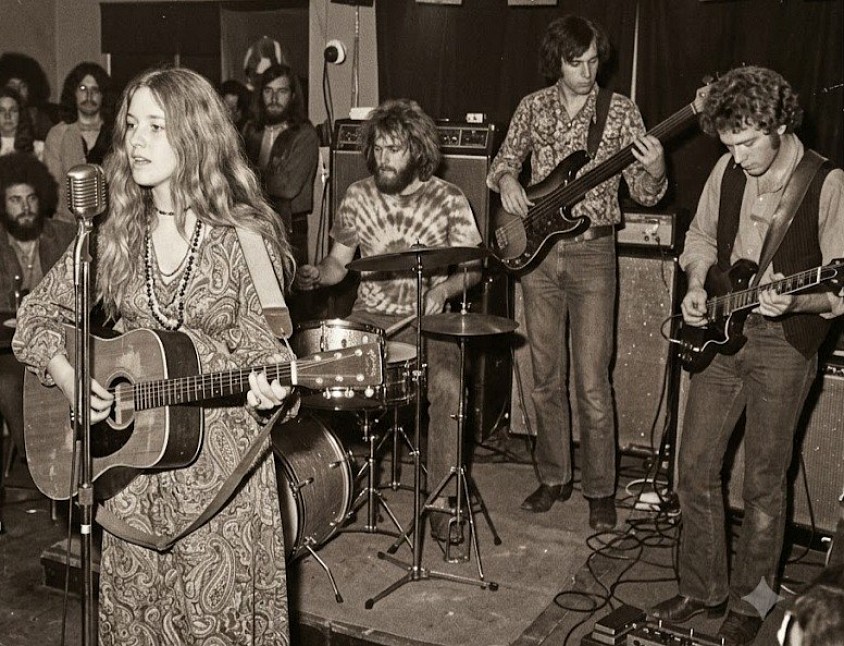
Light the Lanterns and this image mesh perfectly for me. When I first hear the song, such players immediately flashed into my mind. When I first saw this picture, late 60s songs flashed into my mind.
If you research all the different pop music genres of the 60s, 70s, 80s, a discerning listener can tell immediately what era LTL slots into. But, in my opinion, you have to have been alive then to fully contextualize that. I was singing and playing acoustic covers of all the popular folk songs from 1967 onwards. And I can confidently say there was nothing like LTL before 1967. It was mostly banal stuff, and trad folk. Then psychedelia developed 1965-1971, peaking AFTER the SF Summer of Love 1967 and Woodstock of 1969.
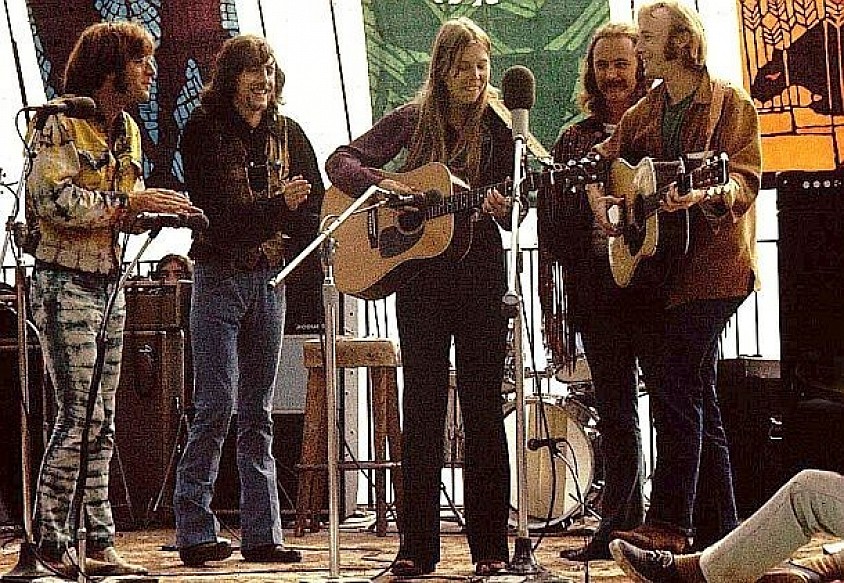
14 Sept 1969: From left, John Sebastian, Graham Nash, Joni Mitchell, David Crosby and Stephen Stills at Big Sur Folk Festival.
Around that time came innovative songwriters like Joni Mitchell and the LA Laurel Canyon mob, who broke the pop music mould. This was a period after 68, when songwriting had truly left the standardized formulas behind. SF and LA were full of musical experimenters. Creative people started writing and singing about anything and everything. Chords modulated all over the place. It was no longer just I-II-IV-V-VI chords like the old Hootenanny hum-and-strum folk. The LTL songwriting is reminiscent of a writing and playing style before these creative years -- certainly not as complex as CS&N and Joni!
I'd describe the lead guitar break in Light the Lanterns as only moderately trippy -- not full on acid-based like many of that era, particularly the Haight-Ashbury hippies. LTL is softer folk-rock. But the lyrics do contain numerous phrases which are clearly marijuanic in origin.
Cultural Lexicon:
The "marijuanic" vibe is a linguistic time-capsule.
In the 80s, "trippy" meant neon lights and synthesizers.
In 1969, it meant exactly what you hear in these lyrics and the music,
a slow-burn, only slightly paranoid, a West Coast folk-lament.
In terms of popular sound, look up "The San Francisco Sound". There is no more appropriate musical category for LTL than that. Note particularly the "Associated Artists" list on that page. I have delved deeply into that list and none match LTL in sound or personnel. But many are similar. In my opinion, the LTL singer and band just missed out gaining a mention in history.
In short, LTL reminds me of a lament for previous times. It is a kind of late-electric-folk, early-folk-rock hybrid, lyrically and musically. That's why I'm going to stick my pin in at it being a 1969 recording -- purely from its sound. But due to historical evidence within the lyrics, I'm proposing that the story itself is from 1962 - 1964 when the narrative was witnessed, with the lyrics composed in retrospect, with a recording period of 1968 to 1969.
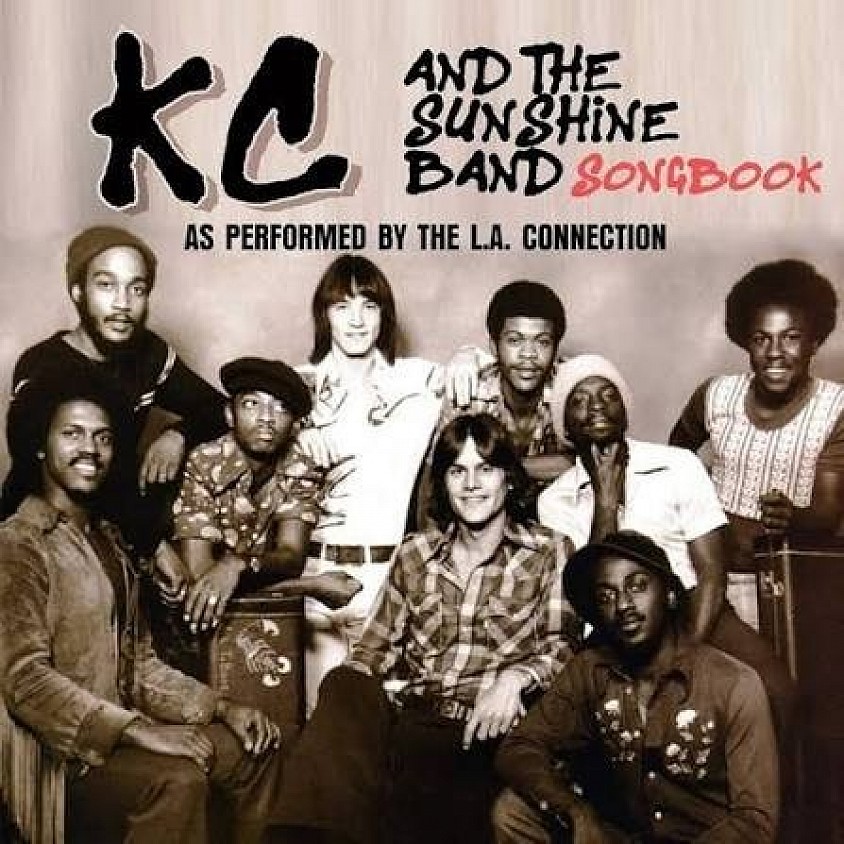
KC and the Sunshine Band. Disco, bump and grind. 1972.
And Then Came the 70s
As old genres fade out and new ones appear, most writers and players join the newly emerging bandwagon. For example, the beginnings of heavy rock, glam, disco, and proto-punk, R&B, middle-of-the-road like The Eagles, etc. And nowhere embraced all these new musical styles more than trend-setting LA. The San Francisco scene moved into dedicated folk-rock, heavier rock, post-acid, plus the beginnings of jazz-rock fusion, which began in 1969 around the same time.
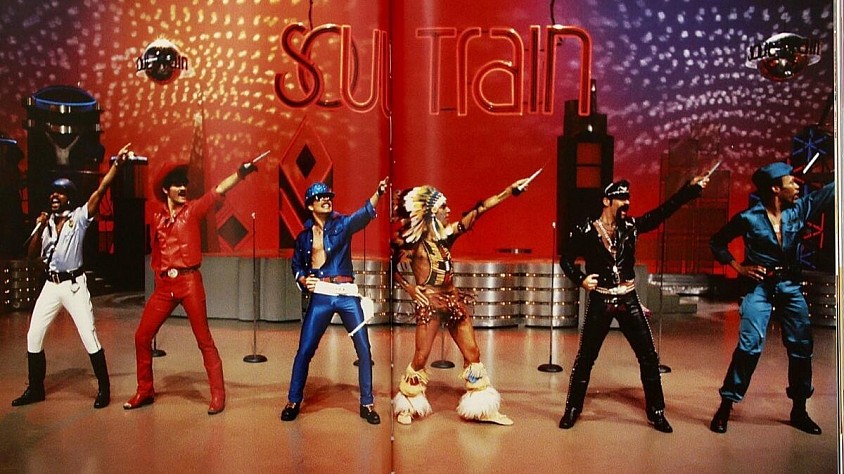
Village People. LA, 1977. Say no more!
All this definitely points to San Francisco 1966, 1969. No-one in New York or Nashville at the time was writing such stuff. That was all Lou Reed and Willie Nelson -- although it does have musical but not lyrical similarities with Greenwich Village writing, such as Simon and Garfunkel.
Light the Lanterns rings with nostalgia -- hardly a message for the fun and groovy 70s, or the self-obsessed, angsty 80s ballads. LTL just doesn't belong in the 70s, lyrically or musically. Who would write and record a demo of something like LTL to compete with all those styles which came in in the 70s? And what record company would promote LTL into the new musical styles of the 70s?
In the 70s, popular music went in a very different direction to the end of the 60s. The Summer of 67 was dead. SF moved on to dirty drugs and much "harder" music. LA even more so. Woodstock became Altamont. Remember? The pacifist city hippies dispersed for the hills. Sadly, Peace, Love and Good Vibes faded. Clearly Light the Lanterns was before that turning point (1970).
And The 80s?
Well ... as relevant to Light the Lanterns in terms of musical style and lyrics ... just not worth discussing.
* * * * * * * * * * * * * * * * *
Why Light the Lanterns Missed Out
* * * * * * * * * * * * * * * * *
So why might LTL not have ever reached popularity? Because, in my opinion, it is a well written, captivating, highly lovable song. But what elements was it missing?
Let's be honest, our singer was only mediocre. Even today, her voice does not stand out. She sounds like so many other average singers. However, that "average" quality is also its charm. It doesn't sound like a polished pop star; it sounds like a real person singing a real story. There is a fragility and sincerity in her tone that fits the tragic lyrics perfectly. A "powerhouse" vocalist might have actually ruined the delicate mood of the song. SF musicologist Joel Selvin called LTL "pretty generic, 68-69", meaning forgettable in its tone. Anyone on pitch could sing that. I doubt she'd get a one-chair-turn on The Voice today!
The era for such a song was over. The 70s did not want such a song. The lyrics about some spooky island, crazy ladies, a dying lantern ritual, would have been pretty irrelevant to most listeners by 1970. That's what makes it so ridiculous that it could be a 70s or 80s song, as many have suggested. Who would make this LTL demo in 1972 - 1985? Only those unfamiliar with the era’s distinct sonic signatures could think that.
The West Coast recording industry lost its experimental, adventurous spirit after the heady acid phase. It went for the safe, popular, profitable, big stars within the EMERGING genres ... as it always does.
The 1970 Industry Reset:
Historical records show the mass closure of independent subsidiary recording labels between 1970-1972 as the industry consolidated.
The LTL demo is a survivor from a professional ecosystem
that ceased to exist before most of today's Lostwave seekers were even born.
A perfect example is the famous Tower Records, which had a subsidiary recording arm within Capitol Records in LA 1964-1970 which aimed to "record and promote innovative garage bands". I truly wonder if the LTL demo tape might have been found in the old Tower Records office building. I did search ALL the artists ever recorded by them. But nobody like LTL (as a band, or like our singer) turned up. Guess they got ignored or rejected at the first contact stage. Check it out. See "Other Tower Label Artists".
So What Might Have Been The Story Behind The Neglected Demo Tape?
Beyond its personal rejection, the physical survival of this unreleased demo likely points to a sudden studio abandonment. When independent labels collapsed during the 1970 industry consolidation, thousands of uncatalogued master reels and acetate discs were left behind in dead-talent storage rooms. The tape may have originated from a small regional radio station, where travelling songwriters left unpressed demos hoping for airplay. Alternatively, it may have survived within a fly-by-night Hollywood audition room or custom vanity studio. When these storefront operations abruptly went bankrupt, shelves of unlabelled recordings by forgotten amateur vocalists were boxed away in basements.
In those days there were just so many musical and movie star wannabes competing for stardom. Beyond her mediocre talent, maybe our singer lacked the specific image sought by promoters. I mean look at Joni Mitchell, Linda Ronstadt, Joan Baez, Grace Slick, Carly Simon, Michelle Phillips -- all industry backed singers with iconic voices and looks.
Conclusion
But there was nothing essentially bad about the songwriting of Light the Lanterns, nor its catchy musicality. We can thus conclude that LTL was NEARLY a one-hit wonder -- an amateur cum semi-professional creation that simply fell through the cracks of a shifting industry and consumer tastes.
We will now dig deeper into the actual instrumentation, what was making the sounds inside Light the Lanterns and how that also helps to nail down the song's age.
