
SHIPWRECK, RESCUE, ATKINSONS, ILLUMINATION NIGHT
* * * * * * * * * * * * * * * * * * * * *
How Did My West Coast Thesis Unfold?
From first hearing, I had never swallowed the Martha's Vineyard story. I had instinctively visualised an isolated, spooky, treacherous, rocky island, with a history of shipwrecks. That meant it would have had a lighthouse, probably off the coast somewhere -- not a comfy middle-class weekender islet like Martha's Vineyard which is 40 mins by public ferry or an airplane for the rich!
About 5 years ago it took only one Google search with a collection of these terms:
- "US West Coast; offshore rocky island; shipwrecked sailors; gingerbread houses; historical mythology; lighthouse".
And bingo, up came South East Farallon Island, CA. I had sensed all along that Light the Lanterns was the notorious, late 60s, San Francisco Sound. Anyone who lived through that music genre would recognise it. So that is why I included West Coast in the search. - My second search was: Women born on SEFI?
And bingo, up came only two, ever:
(1) Farallon W. Cain was born on South Farallon Island on April 8, 1898 and
(2) Delpha Elizabeth Atkinson, born 1927. I ran with Delpha because ... guess what ... her mother was called Grace! That immediately locked in Delpha as the She in the story and that her mother was the Grace who got drunk in the Chinese restaurant. We were off and running. Even back then, everything was too connected to be purely coincidental.
And from then on, every keyword in the song's lyrics started matching up with factual research (except one, which still evades me).
- SEFI has a 400 year spooky mythology.
- It was the site of 400 wrecked ships.
- It had three gingerbread houses.
- Tricky kerosene lanterns were the norm on the island.
- Then I found evidence of a 1944 WWII Homecoming of shipwrecked sailors and an epic nighttime rescue effort.
- A Chinese restaurant was only 15 minutes from where Grace and Delpha lived.
- And this was all within a region well-suited for a female hippie guitarist involved in the 60s alternative music scene.
- And yet to this day, one phrase still escapes evidence ... the whereabouts of the mysterious Illumination Night.
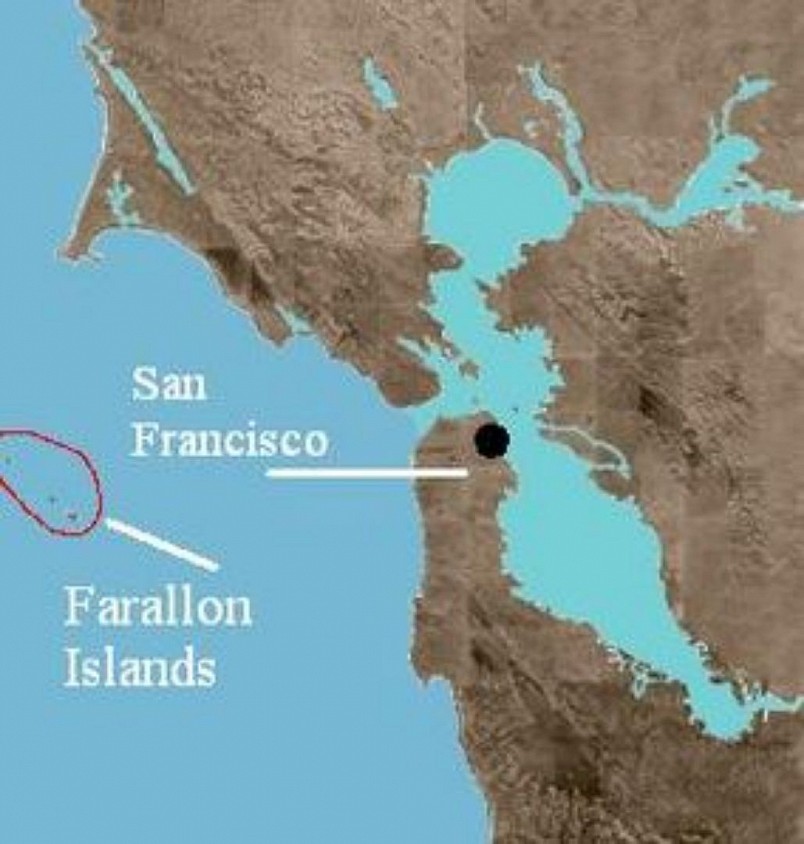
The Dangerous Farallons, just 3 hours steaming away from a Wartime "Homecoming".
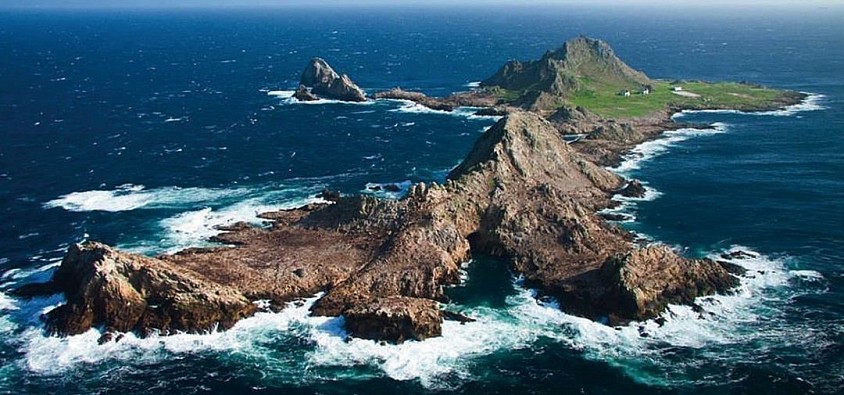
The Devil's Teeth - A very nasty place to run into at night when you're not expecting it!
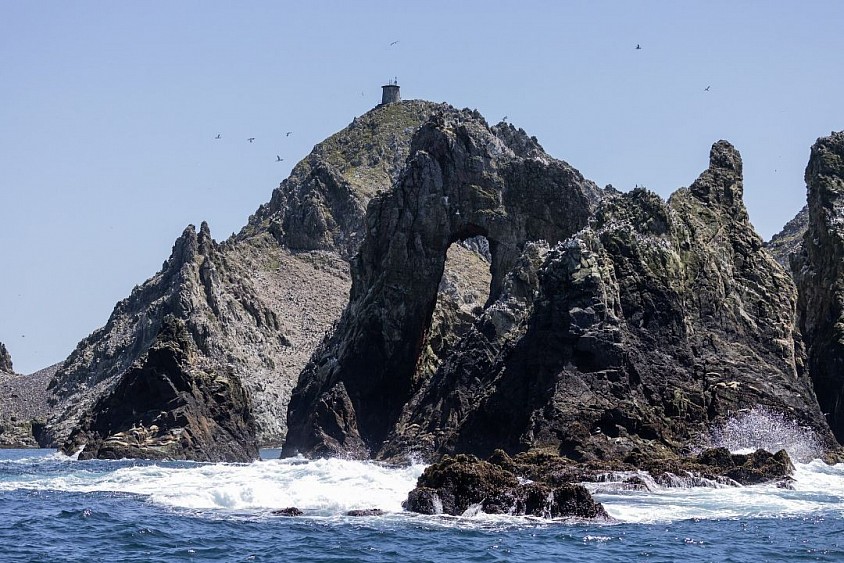
100% jagged rocks all around the foreshores. A lighthouse with fog horn visible on the top.
Light the Lanterns is actually a piece of lost Americana. It is in essence a classic 60s folk song. A lot of people understandably miss this aspect of the song. They are obsessed with finding the singer and they dismiss the words as not being a real folk tale. But behind its cryptic poetic minimalism, lies a true story of great heroism. And evidently more a California maritime folk tale rather than one set in Oak Bluffs on Martha's Vineyard, Massachusetts!
The seeds of all memorable folk songs start with a real-life story, or sometimes an embellished tale -- some mundane, some epic, like this one. There's undercurrents of hope and despair, success and failure, heroes and villains, loving and losing -- all dramas which capture the eternal journeys of us mortals.
But whereas folk poets like Woody Guthrie, Bob Dylan, Phil Ochs, Pete Seeger, Tom Paxton included all the names and places and times within their folk songs, Light the Lanterns is strangely, perhaps intentionally, cryptic.
So let us begin unravelling this fascinating story. The précis below, based on the lyrics, shows the immediate interconnections of the song's lyrics with history and geography. Following that, I will flesh out the researched details of how the whole story has unfolded since the beginning.
"She was born ..."
As just mentioned above, Delpha Atkinson and her mother Grace were the sparks which led into the rabbit hole of the Atkinson family. If I could make contemporary connections with the Atkinsons, that is there we would find our singer.
"... on a magic island"
South East Farallon Island was well known in folklore as spooky but not magical. The impression of it being magical was later found to be an invention of the songwriter who never went there but imagined it might have been magical.
"There's a certain mythology"
The Faralon Islands have 400 years of native mythology. They've been called The Islands of the Dead, The Devil's Teeth, Drunk Uncle Islets. They've been bad luck for so many mariners. The seas around them are a breeding ground for great white sharks. This mysteriousness seems to have set the mood of the song, the backstory of the characters, and the mystery illumination night. It makes the song a bit spooky ... as many listeners have commented. In the mind of the songwriter, only a few "crazies" would ever want to live out on such desolate rocks. But lighthouse keepers and their families did. And what sort of woman gives birth out there, one may well ask???!!!
"I was already on the outside, I wanted to be what I wanted to be"
That's a hippie girl talking, a renegade, an idealist, one who wants to adopt something a little bit crazy, spiritual -- like a legacy lantern-lighting ceremony with only 2 surviving participants.
"She took me to illumination night, to pass on a legacy"
So Delpha took our singer (somewhere?) for her first illumination night which must have been dying out. The singer must have been agreeable to going along and, as she later sings, happy to go back next year to see if she can light the lights and carry on the legacy.
"Crazy ladies in gingerbread houses"
The gingerbread houses on SEFI were classic coastal dwellings built in 1880. It would have been a pretty austere life out there. Yep, we could safely assume that the singer thought they were full of crazy ladies. And maybe she'd just met one of them in Grace!
"Light the lanterns for the shipwrecked sailors"
I soon discovered the history of one particular shipwreck on the Farallons, at night, where all 1,400 sailors were rescued alive by the efforts of the island's residents. That must have taken a LOT of lanterns. Later on I discovered there were 50 US Army soldiers on the island during the war. And that's a LOT MORE lanterns for the rescue effort!
"Celebrate the homecoming"
Those 1,400 sailors were in fact celebrating their homecoming from the Pacific Theatre in WWII when their ship hit the rocks.
"Celebrate the moment when, the will to live collides with love"
The will to survive a war, plus the will to survive in icy waves at night to swim to the rocky shore, was rewarded with love from their rescuers. Collide is a great word for a ship on the rocks whose survivors end up in a fateful collision with the "crazy ladies" who rescued them.
"Lights the lanterns everyone ..."
This was no doubt a clarion call on the rescue night itself, as well as to those in later years who wish to commemorate the event through the rescued illumination gathering.
"... and pray that the rain won't come"
This clearly signals the singer's fear that rain might wash out the illumination night ceremony.
"She left me with Grace the next year"
It is indeed odd that the initiator (Delpha) would disappear on the singer's second year, leaving her alone with Grace ... maybe as a back-up coordinator.
"She went away, I don't know where"
And Delpha gave our singer no explanation -- possibly jeopardising the legacy they had all wanted. It's also odd that Grace never told our singer why Delpha, her own daughter, did not turn up. Perhaps even Grace did not know Delpha's reasons for being absent, or maybe they'd had a fall-out.
"Grace got drunk in a Chinese restaurant ..."
Poor old Grace, as we later find out, had some skeletons and life traumas.
"So all I saw were the lights extinguishing"
The singer laments the legacy handover might fail without both Delpha and Grace's input. Possibly because Grace wanted to bow out of the tradition too.
"I'm going back on illumination night ..."
But no, our idealist singer is resolute to keep alive the tradition, even, it sounds like, without Grace or Delpha.
"To see if I can light the lights"
She's going to give it a go, as tricky as it might be.
And then the chorus repeats the song's celebratory positivity for the future to keep the illumination night alive. And what happened then? Let's now return to the backstory of the major elements.
* * * * * * * * * * * * * * * * * *
The Mythological Farallones
** * * * * * * * * * * * * * * * * *
Marine biologists, divers, researchers have long referred to the jagged underwater topography and the specific crags where great white sharks hunt as "The Devil's Teeth." The name arose during the California Gold Rush era (starting around 1849) when maritime traffic into San Francisco exploded. The moniker is rooted in several factors:
Geomorphic Appearance: When viewed from a distance or approaching through the dense coastal fog, the jagged, sharp granite peaks of the islands look precisely like a row of broken, menacing teeth cutting through the ocean surface.
Navigational Hazard: The islands are surrounded by blind reefs and unpredictable currents that completely destroyed hulls. To the sailors who had to navigate the treacherous waters without modern radar, the islands were a death trap that literally "chewed up" ships.
Native American (Coast Miwok & Ohlone): The islands were the Noo-koo-lah-lah (Islands of the Dead)—a sacred, taboo realm. They served as the physical portal and "jumping-off place" where the spirits of the deceased left the California mainland to cross over into the afterlife. Because it was the realm of the dead, the living strictly avoided setting foot there.
Indigenous Alaskan (Kodiak / Alutiiq): Brought to the islands as forced labor by Russian fur traders, these maritime hunters viewed the Farallones through an animistic lens. For them, the surrounding sea otters and seals were spiritual beings wearing animal "skins." The islands became a site of intensive spiritual negotiations, where hunters used amulets, pristine clothing, and strict post-mortem rituals (like offering the dead animal fresh water) to appease the spirits and ensure they would reincarnate.
Spanish Explorers: They viewed the islands through a Catholic and maritime framework. Naming them Los Farallones de los Frayles (The Sharp Rocks of the Friars), they transformed a dangerous navigation hazard into a spiritual metaphor—visualizing the jagged, white-capped peaks rising out of the fog as holy Franciscan friars standing as sentinels over the Pacific.
The Portal of Spirits: The islands serve as the final earthly destination or "Jumping-Off Place" for human spirits journeying to the afterlife. According to oral tradition, when a person dies, their spirit travels westward toward the ocean. The islands were strictly designated as the realm of the deceased, native peoples deliberately avoided visiting them.
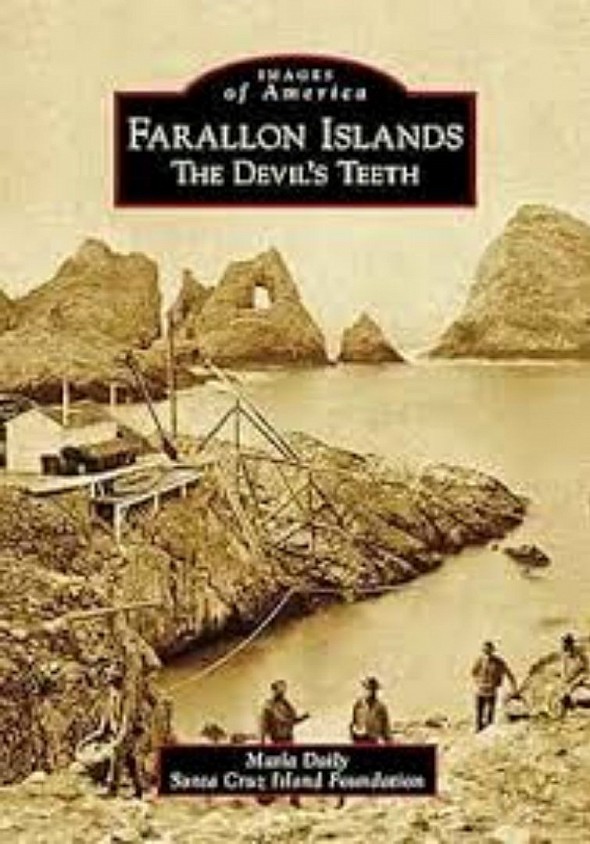
This historical photographic record documents 164 years of isolation, shipwrecks, and desolate lighthouse living on Southeast Farallon Island from 1855 up to 2019.
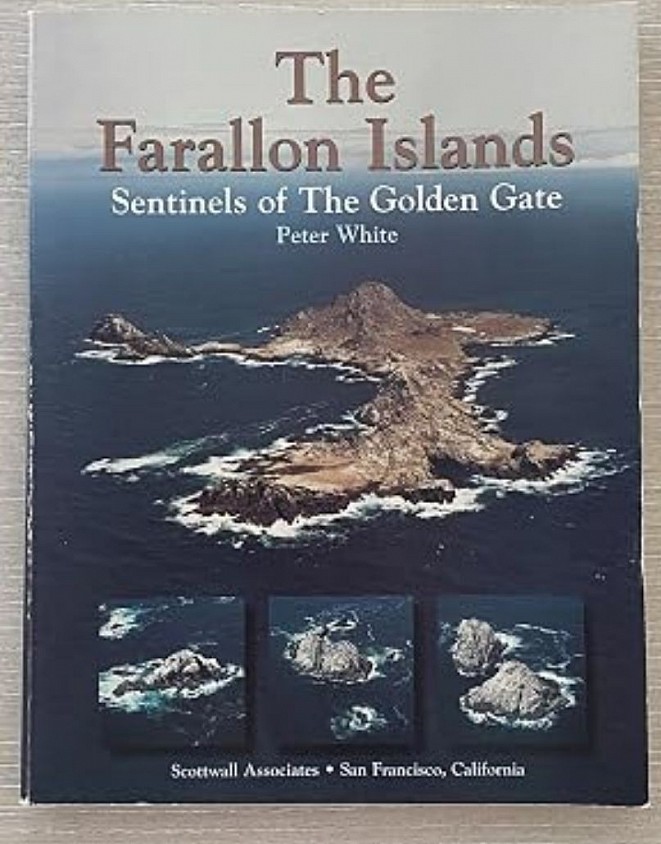
Documents the brutal realities of life on the isolated peaks, from early Spaniards through the bloody 19th Centuary "Egg Wars." Details the hazardous navigation of the surrounding waters, where thick coastal fog routinely blinded captains and led to the destruction of hundreds of vessels on the jagged granite reefs.
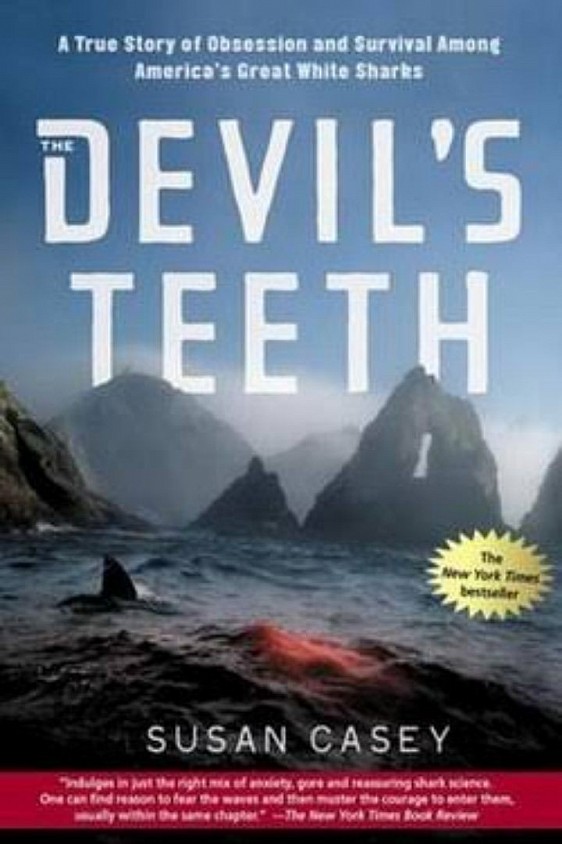
First-hand account of the jagged rocks where massive great white sharks congregate every autumn to savage seal populations in a roiling, bloody expanse known as the Red Triangle.
* * * * * * * * * * * * * * * * * * * *
The Shipwreck and The Rescue
* * * * * * * * * * * * * * * * * * * *
The Story of the 1944 Shipwreck
"The last time I let my joy seep through my sharp-edged discipline, it made me giddy. I did not see the island. I did not hear the whistle. But I would not leave before the souls I carried found a safe place to stand. And the order of my life, abandoned for a moment, held open a window for a homecoming to scramble through."
— Charles Hobson, Shipwreck Stories
On the foggy night of May 31, 1944, the Liberty Ship SS Henry Bergh was approaching the final leg of an east-bound voyage across the Pacific Theatre of WWII, running inbound toward the California mainland. It was only 47 kilometers (29 miles) west of the San Francisco Golden Gate Bridge. Up on deck, hundreds of the 1,400 passengers were loudly "celebrating their homecoming". They had survived the perils of combat and were just a few hours away from passing under that iconic bridge to be reunited with thousands of loved ones with streamers on the San Francisco dock -- home, safe, at last.
But despite the islands being well charted, the action of wind and currents had unknowingly pushed the Henry Bergh off-course. And what was worse, around 5.00am, the fog and darkness surrounding the ship was so thick -- and the partying up on deck so loud -- that the lookouts and the Captain himself missed seeing the lighthouse beam and hearing the fog-whistle from the South East Farallon Island lighthouse. The off-course ship slammed into the jagged rocks of the "mythological" Devil's Teeth -- ironically at a section called Drunk Uncle Islets -- at its full speed of 11 knots.
The Foggy 5.00am Rescue Operation
The SS Henry Bergh immediately started taking on water. But within the next 3 hours, the 27 residents and 50 wartime servicemen stationed on SEFI, plus a flotilla of navy ships immediately dispatched from San Francisco, rescued every single sailor and soldier who had been on board. Can you imagine getting 1,400 often-inebriated servicemen off a sinking ship in the semi-dark, across waves and treacherous rocks on that foggy morning.
Of the total 1,400 on board, 600 made it to the island by either
- swimming 200 yards through the darkness, the fog, the icy waves, and then clambering over the rocky shoreline;
- traversing several breeches buoys (ziplines) which had been rigged up from ship to shore;
- or on lifeboats ferrying 25 at a time over to the rocky shoreline and/or to the island's landing gantry. [See pic]. SEFI is so rocky there is no wharf or jetty or beach to land at.
Another 800 were lifted off the floundering ship and taken directly back to San Francisco by Naval Rescue ships. And after all that, not a single soul was lost. What a tale!
Military Involvement and Secrecy
An interesting thing about the SS Henry Bergh's grounding is that there was substantial information suppression about it at the time. Nationwide, only one San Francisco newspaper made mention of it. Such was much wartime reportage. In addition to the usual 27 island family residents, there were at that time an extra 50 military personnel stationed on the island in barracks for coastal defence, as well as operators of a secret "listening post" against the Japanese. [See Military References below]
While strict wartime censorship protocols and the sudden nature of the maritime accident meant that immediate 1944–1945 newspaper reports deliberately hid operational troop movements -- choosing sterile phrases like "home-bound sailors" or "returning veterans" over public "homecoming" framing -- retrospective historical accounts natively use the term to describe the deep emotional irony of the disaster.
- It turned out from the official inquiry that the ship was nearly triple overloaded with 1,400 passengers, not 564!
- The partying up on deck was against navy regulations.
- There were rumours that the ship's watchman was "involved with the party" (ie, drunk).
- And the Captain? Well, he got demoted to a First Mate "for errors in plotting the course, failing to take soundings, and allowing passenger noise to interfere with the lookouts' ability to hear fog signals".
I suggest the presence of an extra 50 highly organised manpower assisting with the shipwreck rescue would have been a major factor for its success in saving so many souls in such perilous circumstances. It is very doubtful that 27 civilians alone could have managed such a mammoth successful rescue.
Shipwreck Archives
https://www.islapedia.com/index.php?title=S.S._Henry_Bergh
http://www.charleshobson.com/ships/henry1.html
Military References
https://digitalcommons.unl.edu/cgi/viewcontent.cgi?article=1619&context=usdeptcommercepub
https://www.history.uscg.mil/Browse-by-Topic/Assets/Land/All/Farallon-Island/
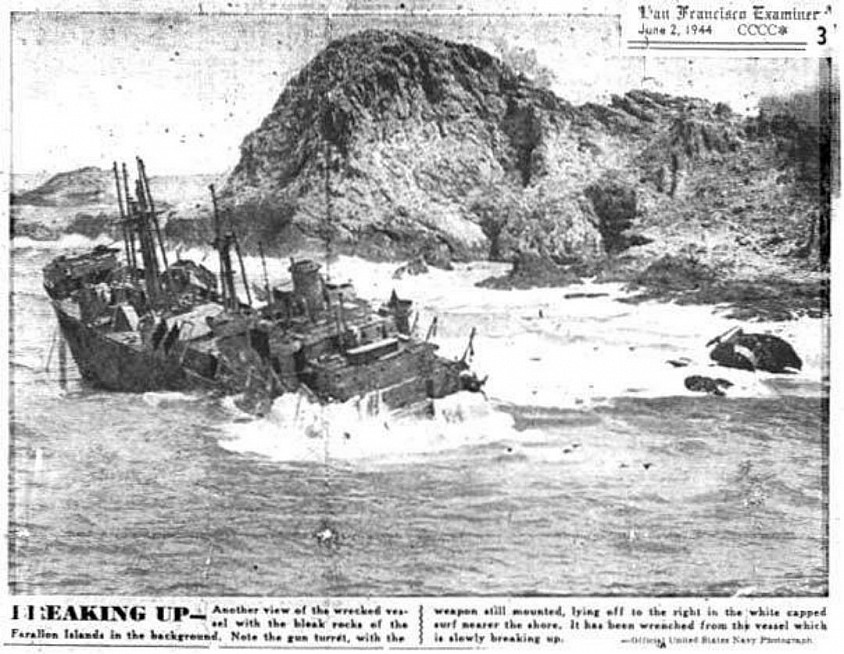
SS Henry Bergh - Broken in pieces after 3 days
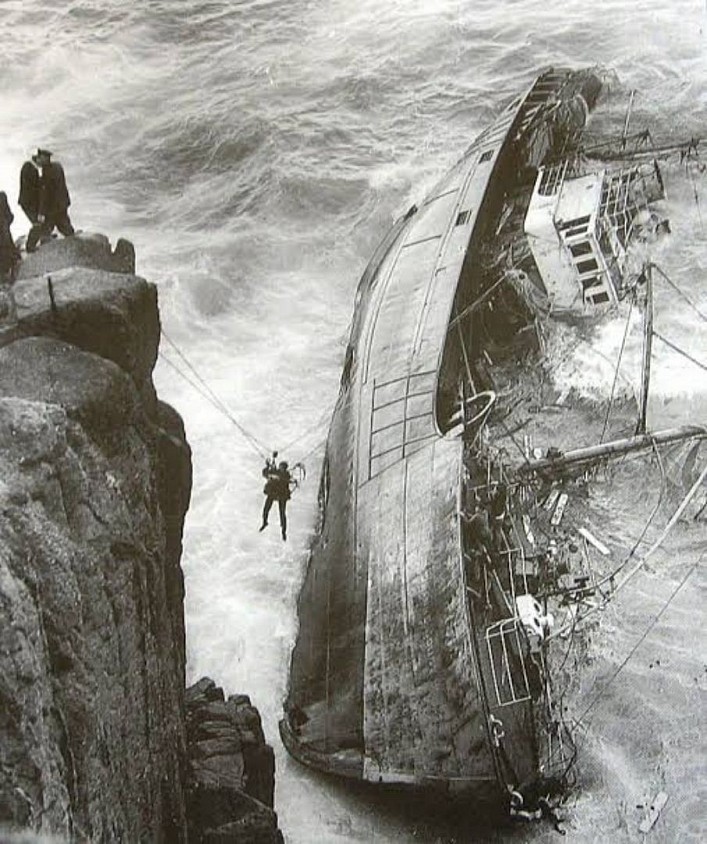
Getting ashore, one at a time, swaying in the wind, hoping the rope doesn't break!
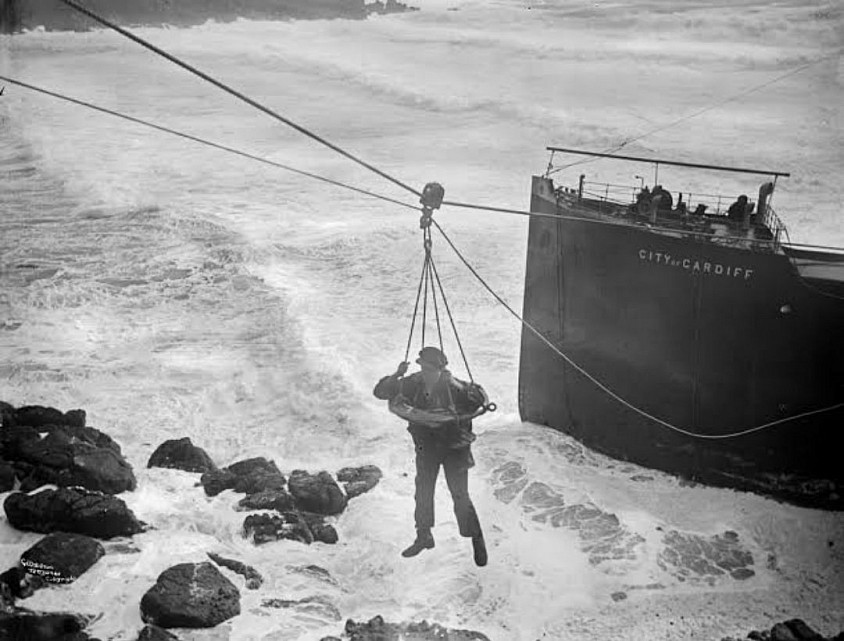
A Breeches Buoy - one way to get ashore
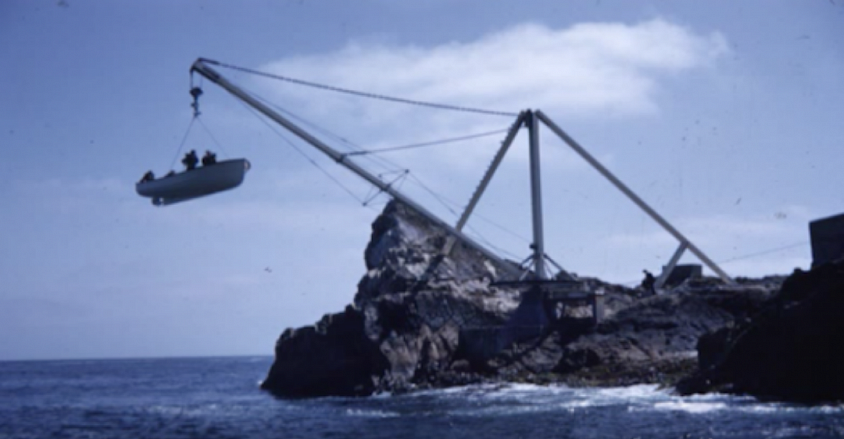
How boats, supplies, people were brought ashore on SEFI ... even to this day.
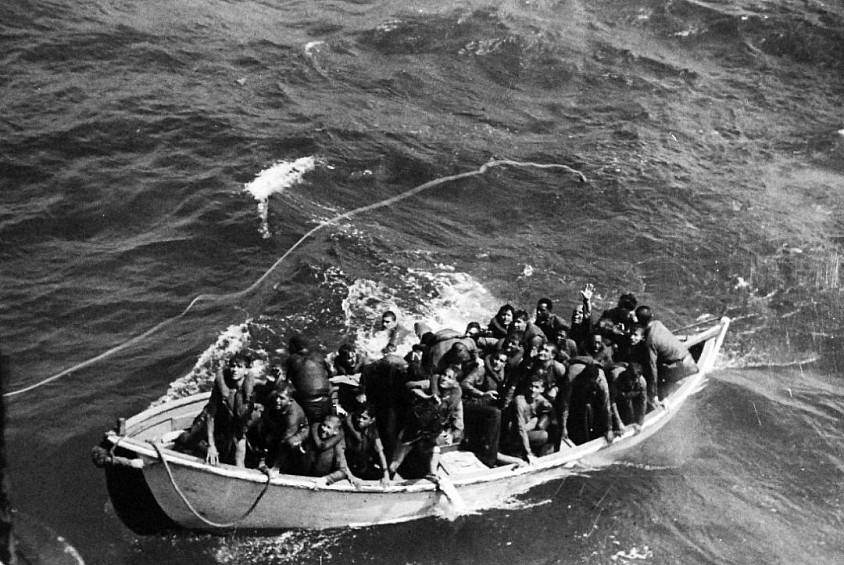
Sailors in lifeboat: 600 made it to shore in 3 hours. Many swam. 800 others were rescued directly off the wreck by Navy Vessels.
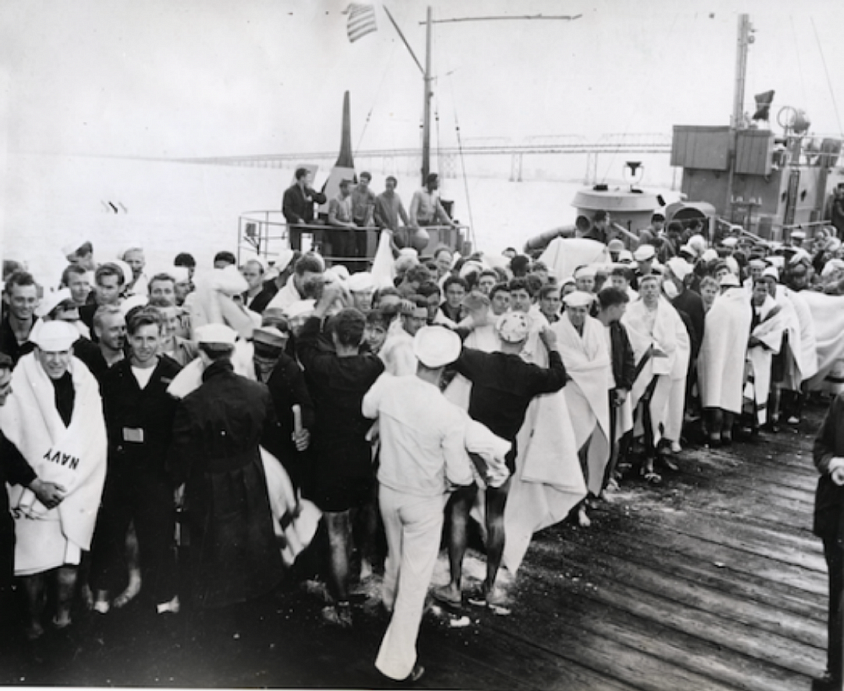
Happy Sailors: Docked in SF on a Naval Rescue Ship, June 1st 1944
The "Crazy Ladies in Gingerbread Houses"
In a 1978 Oral History Radio Interview, Delpha Atkinson states there were three gingerbread houses on SEFI during her childhood there (1927-1931), one for each Coast Guard Lighthouse family. Yeah, not quite as charming as the MV variety!
During the war, army barracks were built as part of coastal security against Japanese ships and submarines. See pic below. In the late 1960s one of the residential gingerbreadhouses house was demolished along with the wartime constructions when the island became an exclusive bird sanctuary.
During the ship rescue, the "crazy ladies in gingerbread houses" -- that is the resident lighthouse keepers' wives and children, plus the wives of other military servicemen stationed there 1939 - 1945 -- would have been furiously filling and trimming the fiddly kerosene lantern wicks and Coleman pressure mantles; "lighting the lanterns for the shipwrecked sailors" till daybreak; bringing dry clothes to the swimmers; then graciously feeding them for four days from their own food stocks.
"They drank all our coffee, ate all our bread and used all our blankets, but they were a wonderful group of boys."
Greta Thompson, Farallon Island resident, 1944.
Shipwreck Stories by Charles Hobson.
The term "crazy ladies" is deduced to be the younger songwriter's own flippant caricature of the well-documented, difficult lives that remote island lighthouse women had to endure along America's rocky coastlines. (See the references following, from Denise Atkinson, one of Grace and Delpha's decendents).
Clearly this massive rescue effort was where the sailors' "will to live collided with (the) love" of their valiant rescuers, as sung in the three choruses of the song.
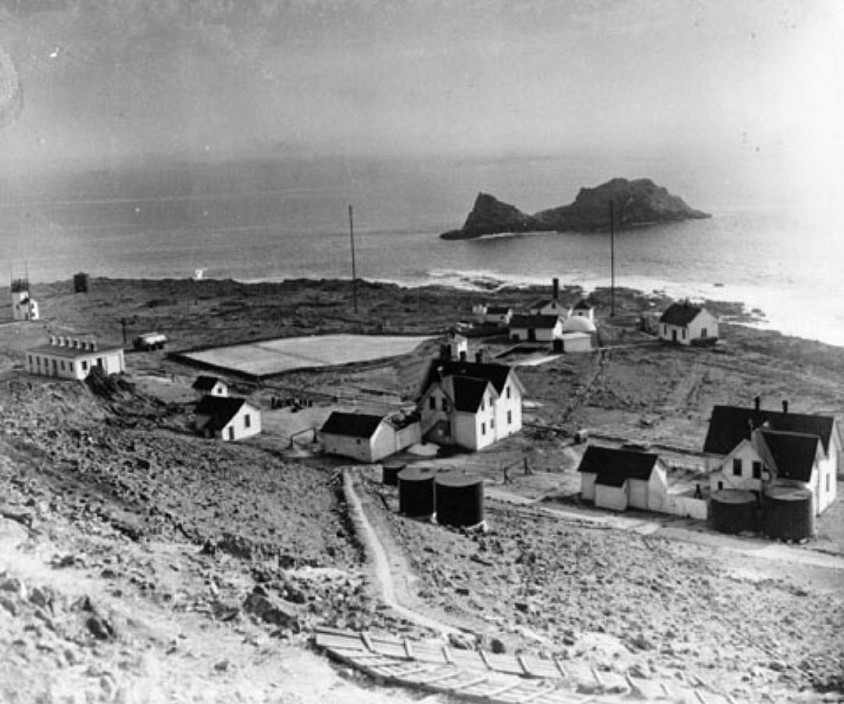
All the buildings in the SEFI colony in 1944. The three keepers' gingerbread houses and various army huts.
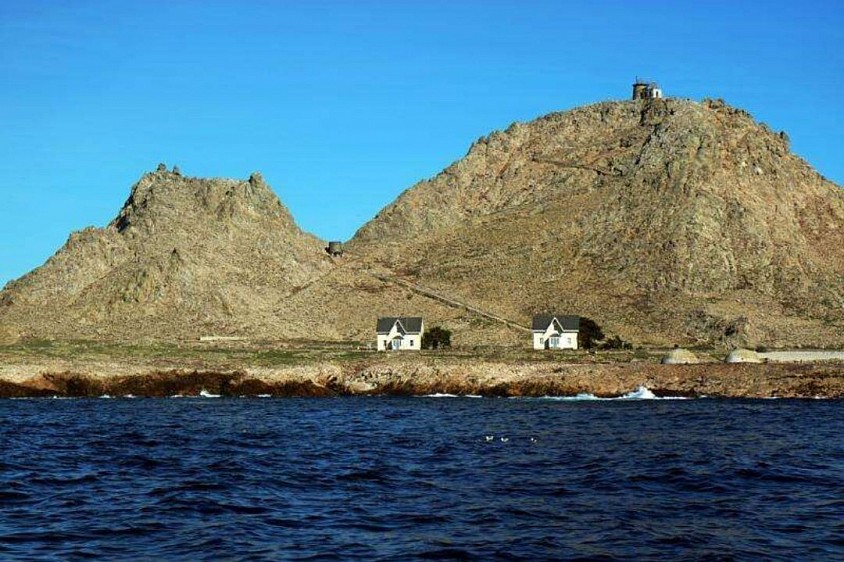
Two of the remaining original gingerbread houses after the island was cleaned up and closed to the public in 1968.
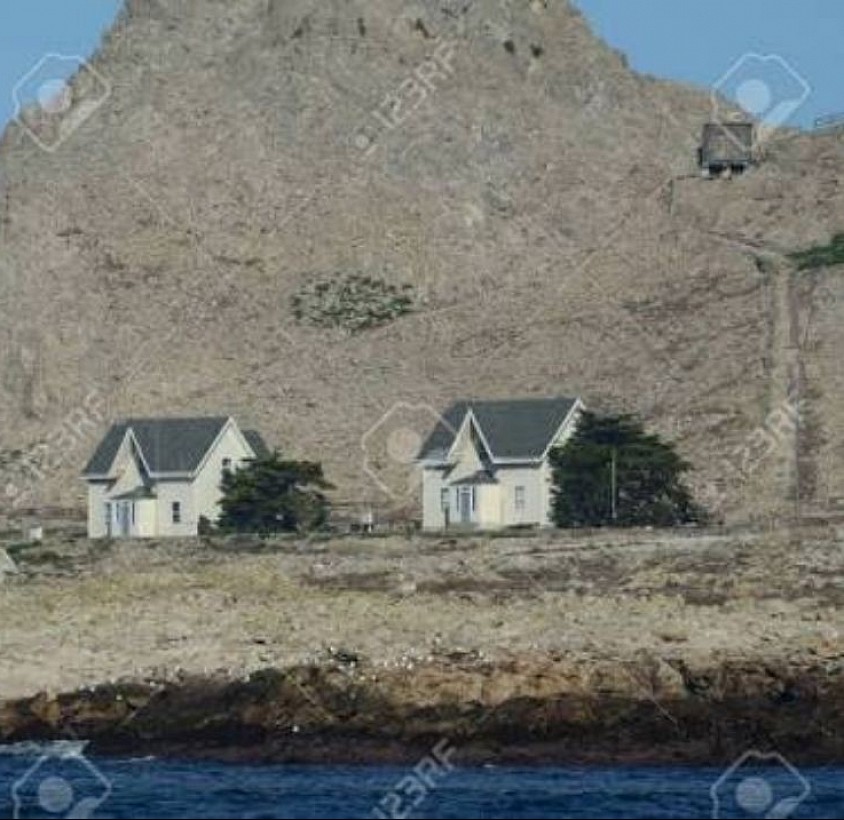
Restored gingerbread houses now used by birdwatching scientists.
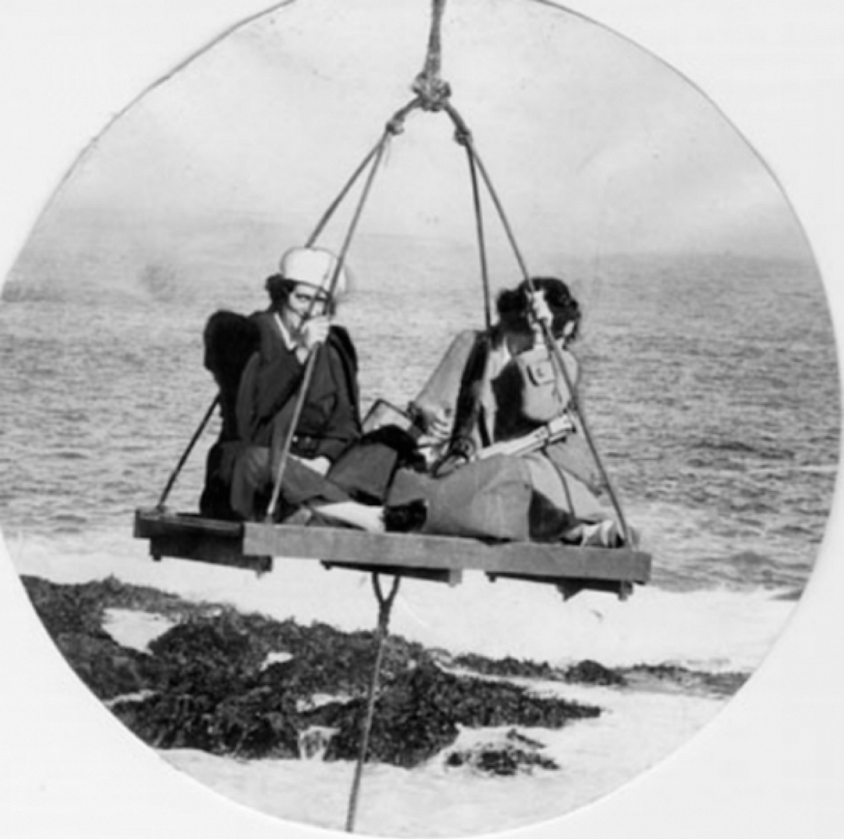
Yep, that looks like a pretty crazy way to get home from shopping in town. Crazy but true.
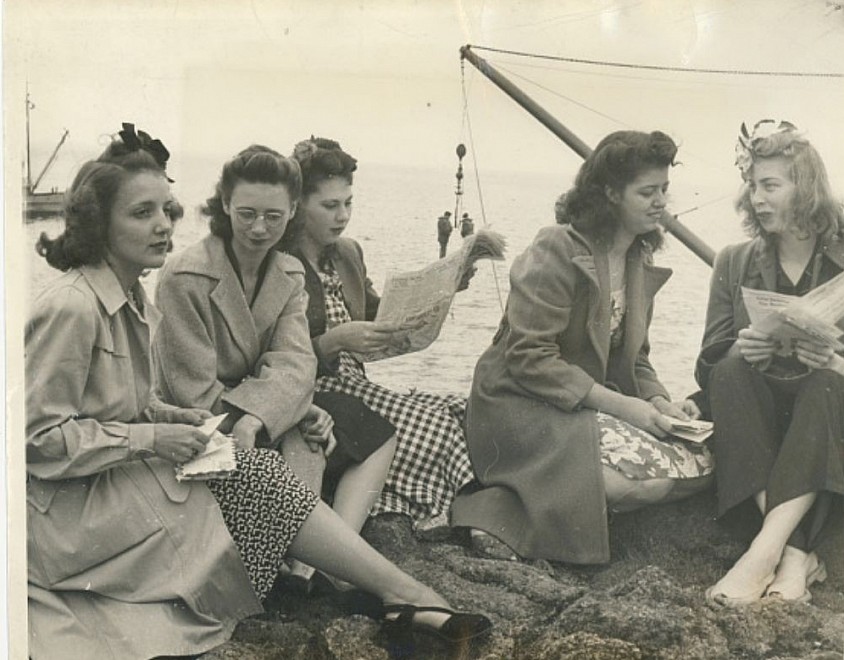
The 5 wives on SEFI, 1940. They don't look particularly crazy! Notice the 2 Coast Guard deliverymen in the gantry sling at back, riding with bags of supplies.
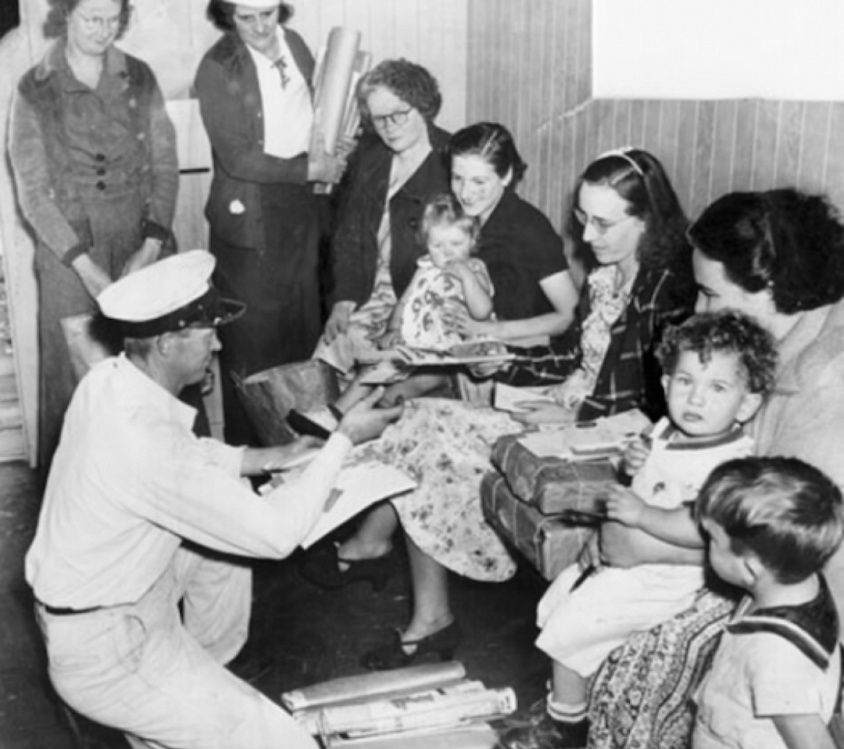
The 6 wives with 3 kids on SEFI 1939. None of them look particularly crazy!
Types of Lanterns
During the rescue -- as you can well imagine -- every available kerosene hurricane lamp on the island (and there would have been a lot) would have been brought down to the rocky foreshores to play a role in marking the safest places for men to swim to and the lifeboats to offload before making more trips back to the stricken ship. [See lantern pics below].
There would have been three basic types of lanterns on the island at that time:
- The Military and Coast Guard issue pressure hurricane lamps (single or dual mantle). These were pretty technical to light and maintain -- not to mention dangerous for the untrained (like our hippie singer-girl). They had the nickname "bomb-in-a-box". They could literally squirt flaming kerosene a metre away from themselves if not primed properly. If handled incorrectly, the mantles would just crumble into dust.
- The common immersion-capillary-wick, external hurricane lanterns. These were less tricky to light and service, but could be tricky in the wind or rain.
- The immersion wick glass chimney type lamps for inside dwellings.
All three are the types of lanterns that the "crazy ladies" would have lit for the shipwrecked sailors in May 1944. But after her move from Pt Cabrillo Lighthouse into Mendocino township in 1950, we can safely presume that Grace Atkinson would have kept lighting the non-pressurised wick-type for her personal illumination night in emulation of the rescue operation. And I think it would be this same type that the hippie-singer feared she might struggle with alone -- especially if the rains and the wind came.
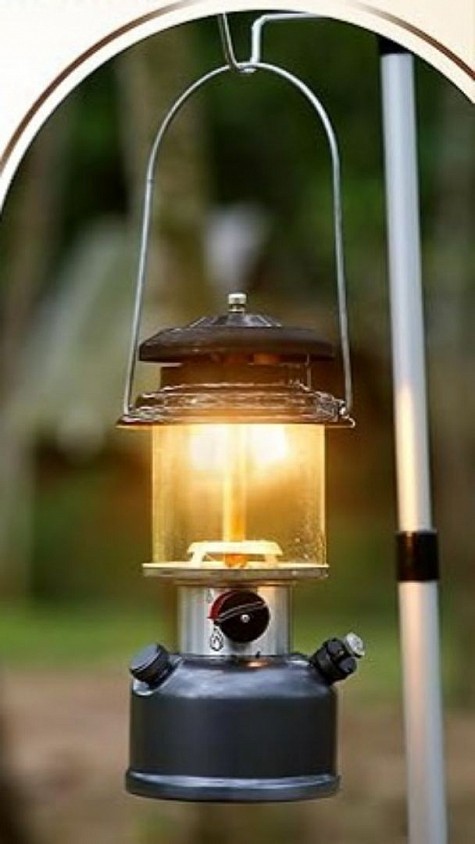
Typical Military and Coast Guard Double Mantle Pressure Lanterns, common at all Lighthouses
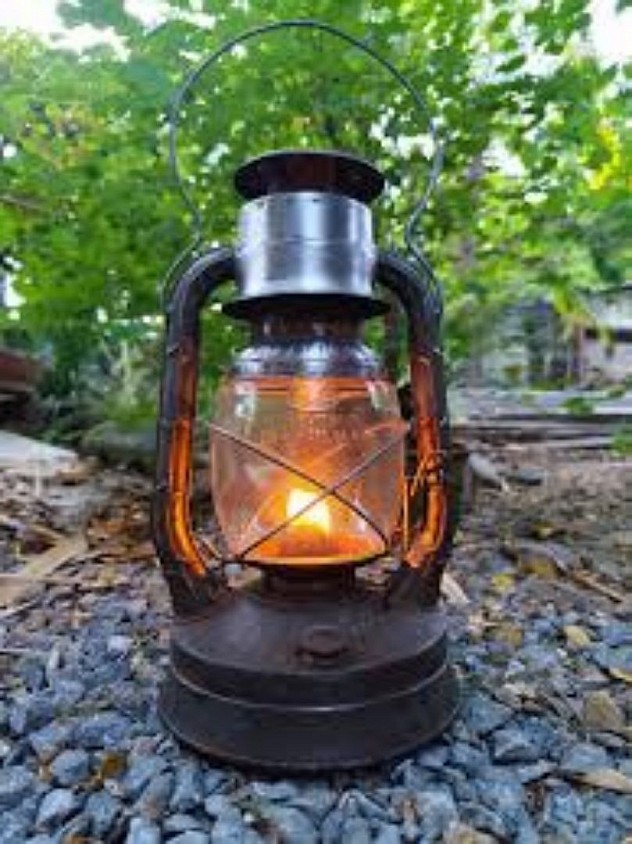
Typical Outdoor Wick and Kerosene Lanterns that the Crazy Ladies would have used during the 1944 rescue
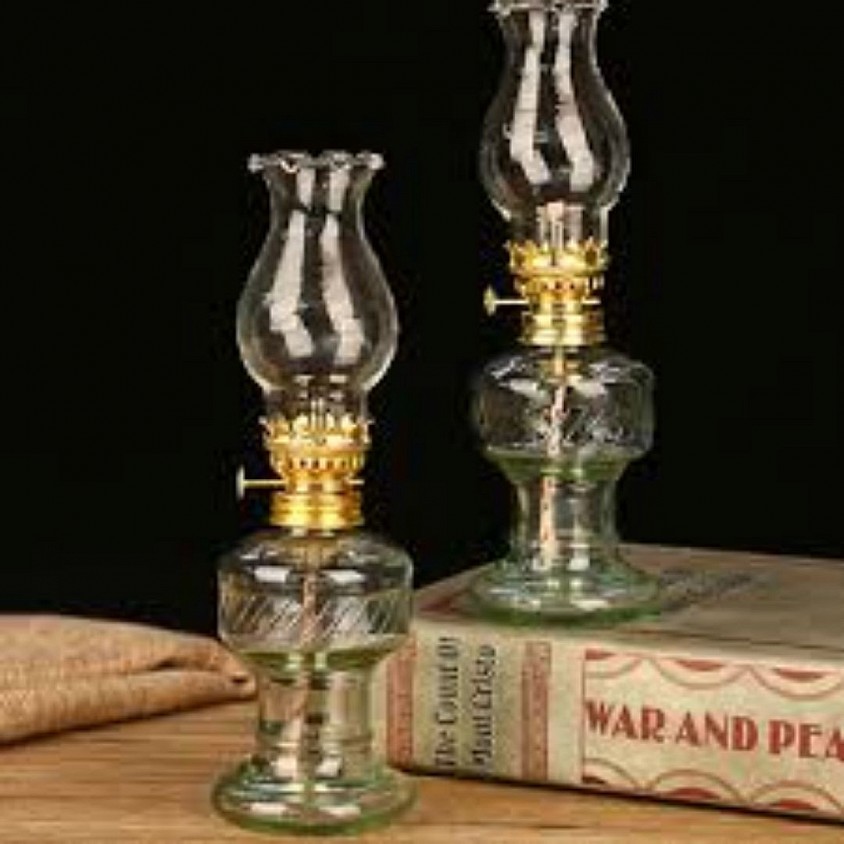
Typical Indoor Kerosene Lamps 1944
* * * * * * * * * * * * * * * * * * *
The Atkinson Family
* * * * * * * * * * * * * * * * * * *
Delving into the history of the Atkinson family may seem like a radical tangent to finding our singer -- but not so. Firstly, it puts real faces, real people into the song, rather than just some disembodied voice that 200,000 listeners worldwide might like to identify. Secondly, each Atkinson has an interconnected backstory which weaves into the song and my thesis about it, which further validates that I'm not "barking up the wrong tree" with my West Coast thesis, or injecting fictitious people just to bolster my story -- as many critics have suggested.
As I first deduced, if Delpha is the "She" in the song lyrics, and her mother Grace was the drunkard in the Chinese restaurant, then our mystery singer must have been either family, good friend, or even just an acquaintance of Delpha and Grace Atkinson. On the first year, the singer met both Grace and Delpha. Year 2 Delpha let her down without explanation. But she was still committed to keeping illumination night alive on the third year. So I'm leaning most towards a casual acquaintance relationship.
So many pointers in the Atkinsons' lives have since helped to narrow down the timeline of lyrical events, the geographical possibilities, and the social connections they must have shared.
So from my first connection to them on South East Farallon Island where Delpha was born in 1927, we must track their movements into the 1960s when the song was recorded. Every little suggestive factoid I discovered led to further facts and other signposts towards our singer. It's been like a massive jigsaw puzzle.
Thomas Atkinson: The Light Keeper
Thomas Allen Atkinson (born 1901) with his young family, was originally a 3rd Assistant Lighthouse Keeper on South East Farallon Island in 1925 and had advanced to 2nd Assistant and then Chief Lighthouse Keeper by 1930.
His wife, Grace (born 1907), unexpectedly gave birth on the island to their first born daughter, Delpha Elizabeth, born 6 weeks early on 19th Feb 1927.
In 1930, Thomas and family were transferred from SEFI to Point Vicente Light Station (1931 - 1935); then to the Humboldt Lighthouse (1935- 1939); and then to Point Cabrillo Lighthouse between Mendocino and Fort Bragg in 1939, where they remained until Thomas's death "on the job" in 1950.
Thomas was a United States Coast Guard (USCG), 1925 - 1950, specifically under Navy command 1939 - 1945.He was a Master Mason (Freemasonry), a member of the Fort Bragg Lodge 1939 - 1950.He was buried in the Golden Gate National Military Cemetery, located in San Bruno, San Mateo County, California.
In her 1977 Oral History Recording, Delpha described her father as kind, careful, fair, well liked and respected, a good father and husband. As a Mason, a military man, a church-going Southern Baptist, he was no doubt highly moral.
On May 31st 1944, when the SS Henry Bergh struck the Farallon Island, the Atkinsons were based at Point Cabrillo. There can be no doubt that through the Coast Guard grapevine -- and probably directly from his friend and compatriot James C. Moore, the head keeper on South East Farallon Island at the time of the shipwreck -- Thomas had heard first hand all about the 1944 Farallon Island shipwreck and the massive maritime rescue effort on his old turf. Records mention that there was also a "Navy listening post" right at Point Cabrillo too. So the Navy and the Coast Guard were no doubt closely entwined.
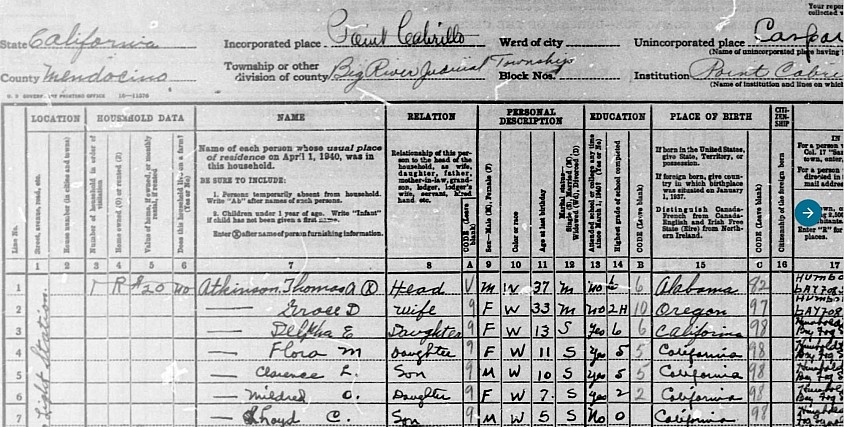
1950 US Census. Whole Atkinson Family Resident at Point Cabrillo.
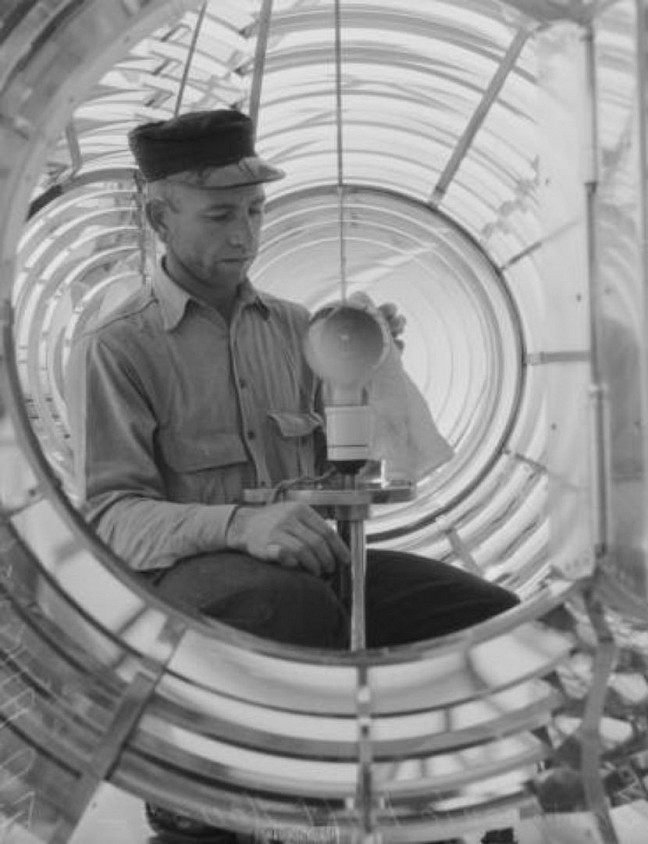
Thomas Atkinson age 30. Inside the Farallon Lighthouse, 1931.
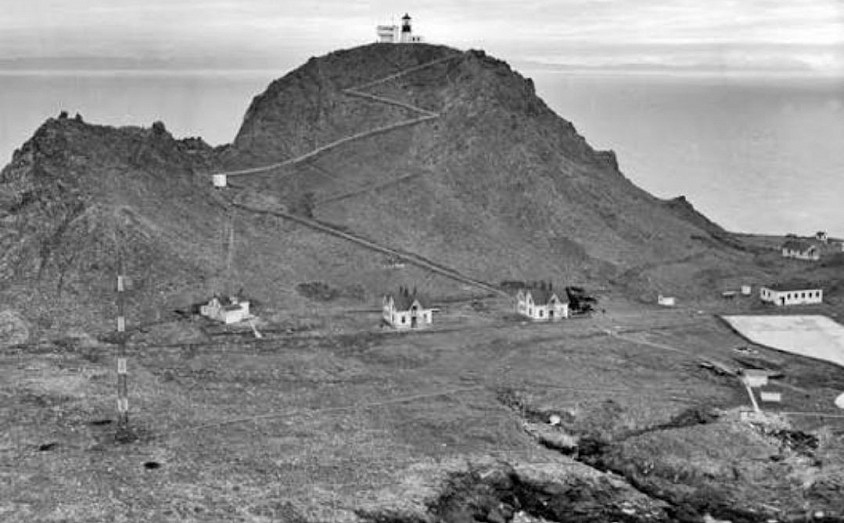
The Farallon Lighthouse. Checkout that walk up to work for every shift.
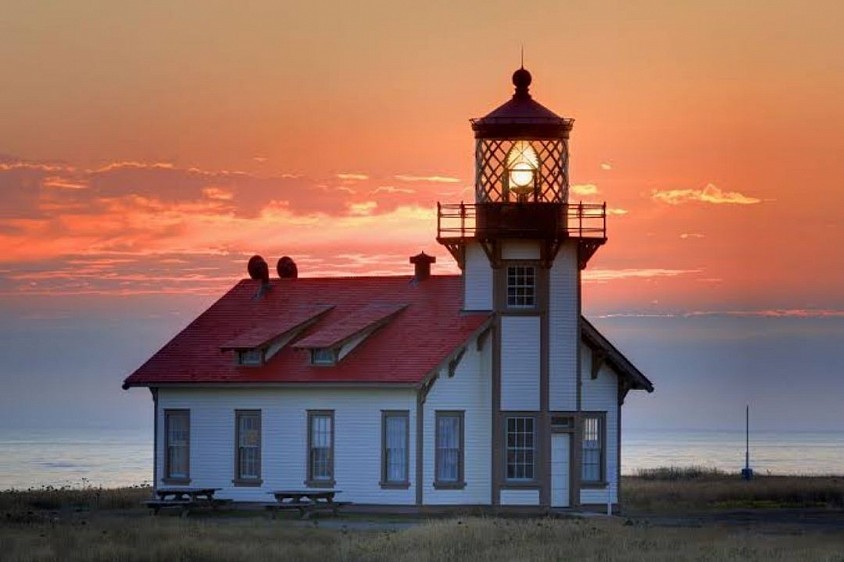
Point Cabrillo Lighthouse. The Atkinsons' home 1939-1950. Not a gingerbread house ... so no "crazy ladies" operate there.
Grace Atkinson: The Matriarch
Thomas and Grace were married ~1926, just before Thomas was posted to the Farallons. From all reports, Grace was a model wife and housekeeper for her family. In her 1977 Oral History Recording, Delpha talks fondly of both her father and mother.
After Thomas's death in 1950, Grace was moved on from her government-provided dwelling at Point Cabrillo. She relocated to a private residence at #20 Main Street South, Mendocino with her remaining 3 children. Her house was right on the headland overlooking the estuary of Big River, Mendocino. From Google Earth and Streetview photos I've seen, that headland looks remarkably like the rocky Pacific Ocean foreshores of Farallon Island!
Grace was a Matron of The Order of the Eastern Star, the female counterpart to The Freemasons, of which her husband Thomas was a member.
There was/is a youth version of Masonism called The International Order of Rainbow Girls, specifically for daughters of Masons and Matrons -- a link I am presently investigating to see if Delpha might have met our singer-girl through such a network.
Now, I'm not suggesting the illumination night was a formal OES or Rainbow Girls performance. But without any doubt, Grace's membership of this secret order would have DEEPLY driven her life even outside of the temple. And Delpha's knowledge of it, along with her high probability of being a Rainbow Girl aged 11-17, adds intriguing elements to our story.
The core philosophies of the Order of the Eastern Star suggest a profound connection between formal temple teachings and private lantern rituals:
- In OES philosophy, "The Light" represents divine wisdom and truth. Lighting a lantern in private signifies:
- Dispelling Ignorance - A symbolic act of seeking clarity in personal decision-making;
- Refining Character - The flame represents the "all-seeing eye" and the constant presence of the Grand Architect, encouraging the member to live according to their obligations when no other members are present;
- Spiritual Continuity - It bridges the gap between the formal ceremonies of the Chapter Room and the practical application of those lessons in daily life;
- OES teachings emphasize Charity, Truth, and Loving Kindness. A private ritual serves as a profound personal commitment to those tenets.
- The lantern lighting would be a way for the member to internalize the "Light" of the Order and carry its guiding principles into her private life.
That sounds a lot more like the illumination night in our song than the Martha's Vineyard candy-houses with electric lights and lemonade.
According to records, Grace ended up leaving her Mendocino house sometime in the 60s when it was demolished by The Union Timber Comoany, possibly feeling that the town no longer held any fond memories for her. All her children had left home by 1951. Grace's cherished youngest son Carl (Delpha's little brother) was killed in a car accident in 1964 at Fort Bragg, aged only 30. We may therefore conclude that any illumination event she had been holding in Mendocino was probably over by 1964-65.
From public records and local newspaper clippings, between 1965 and 1981, Grace seemed to drift between all of her childrens' places and her sister Odessa's -- roving between Grover City, Taft, Napa, San Bruno, Cloverdale, Little River -- all EXCEPT her daughter Delpha's in San Leandro, SF.
Grace ended up buried next to Thomas in the Golden Gate National Military Cemetery in San Bruno, San Mateo County, California in 1981.
Delpha: The Go-Between
In 1944, Delpha left home at the Point Cabrillo lighthouse at 17 and married Cpl David Thomas Andrade (Snr), a native Hawaiian she had met in 1943 and went to live in San Leandro SF until her death in 1993.
Not much is known about Delpha's life after she left the Mendocino area, except that she did return now and then to visit her mother and siblings. Whilst living in San Leandro:
In 1964, Delpha's little brother Carl, Grace's youngest son, died in a Fort Bragg car crash at age 30.David Thomas Jnr was born 1948. David joined the Marines in 1967 for 3 years until 1970. He might have served in Vietnam. After leaving the Marines he had 2 failed marriages. He died by his own firearm in Texas in 1978 in what may well have been a contemporary case of undiagnosed post-Vietnam war PTSD.Denise Elizabeth Andrade was born in 1954. I made contact with Denise in 2024, aged 70, firstly through a niece of hers and later with her personally. She was not at all forthcoming about her family history, despite being the keeper of all Grace's family archives. She was not at all interested in assisting with research into the song's history. She did listen to the song; read the lyrics; read my thesis about Delpha and Grace; but withdrew from contact after only one email and one YouTube post about the song. This was very disappointing as I had hoped she could fill in many gaps in the story. I got the impression she carried the burden of multiple family tragedies -- 3 broken marriages, the tragic death of her older brother David, and her Uncle Carl in a car crash in 1964.Delpha's husband, David Thomas Andrade Snr, died in 1995.
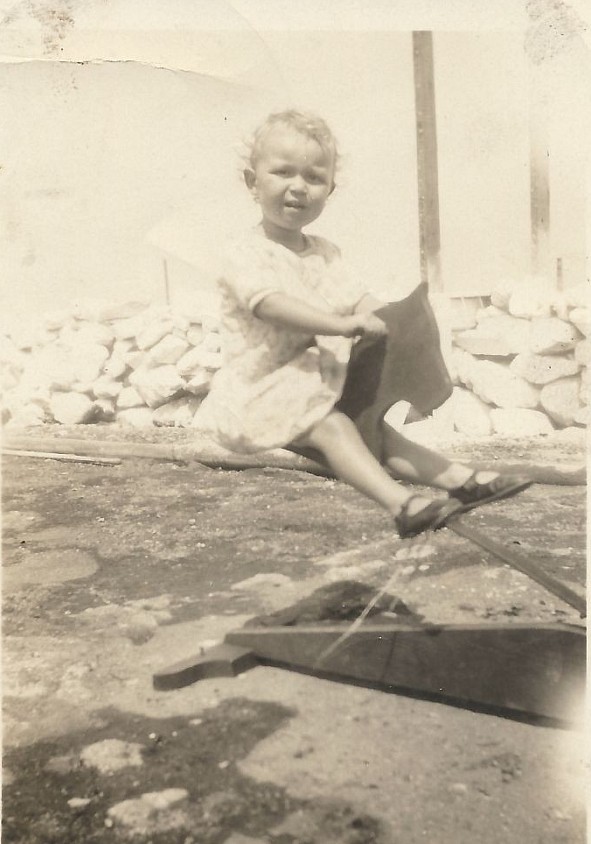
Delpha Elizabeth Atkinson, age 2. Born Farallon Island 1927.
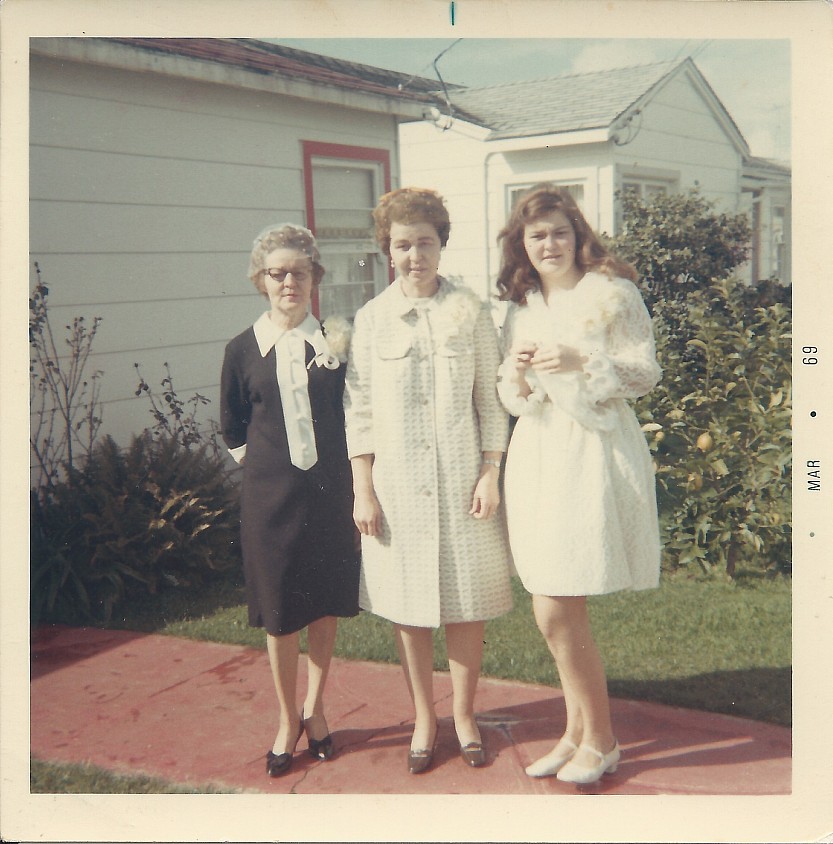
Three Generations of Atkinson Women -- Grace (62), Delpha (42), Denise (15). March 1969.
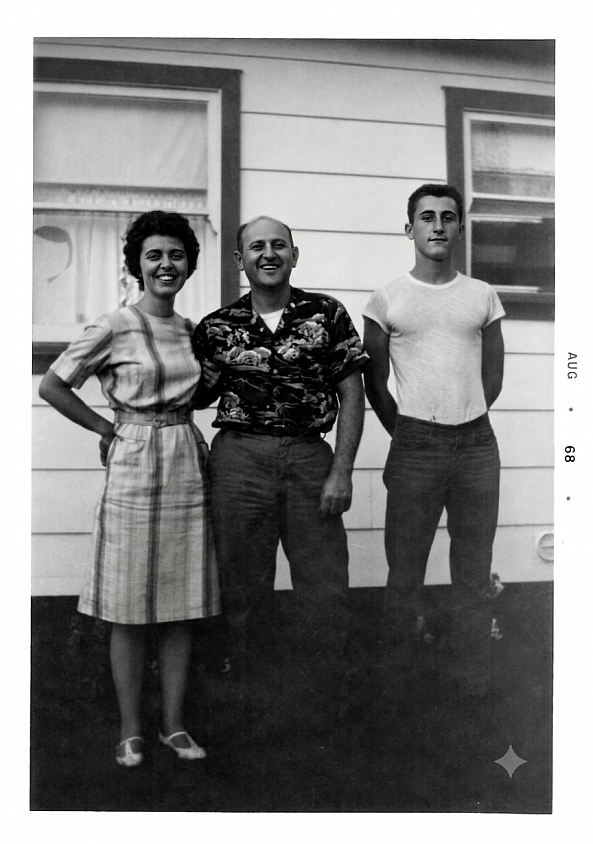
Thomas Andrade Snr (46), Delpha Andrade (37), Thomas Jnr (16). 1964.
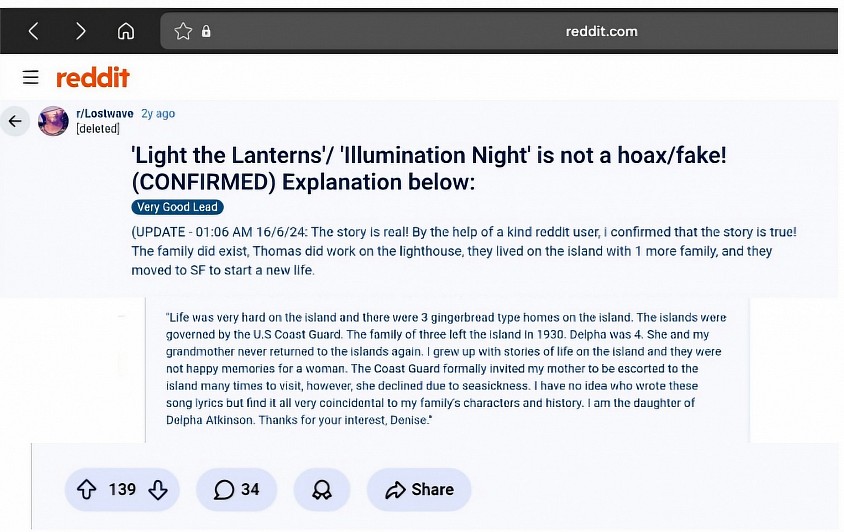
Denise Commented 2024: Partial Confirmation, Partial Denial of Lyrics
Denise Andrade
Amazingly, when I contacted her in 2024, Delpha Andrade (nee Atkinson) still-living daughter Denise Elizabeth (b.1954) did not recognize the song or know anything about any lantern-lighting ceremony her grandmother had performed between 1944 and 1964. I sent her a YouTube link to the song and told her all the strangely connecting history about her mother and grandmother I had dug up to that point, and my thesis about the song's lyrics.
Denise would have been about 8 at the time of the restaurant meeting so I guess it was not surprising that she had been excluded from the illumination night. She did publically comment in the break-out textbox in a YouTube post which did little to verify any facts about illumination night or the singer.
And to me personally, she emailed the following:
- Yes, my mother was born on the Farallons.
- And yes, Grandma Grace did like her drink!
- But the song sounds like the songwriter's fantasy because the island was not magic.
- I grew up with grandma's stories about how hard life on the island was.
- She wasn't crazy, but many would probably think she was, to live out on that desolate rock.
- The only lanterns grandma knew were those smelly old kerosene lamps from the war years.
- Despite the song having family coincidences, I think it sounds like fiction.
* * * * * * * * * * * * * * * * * * * *
The Mystery Illumination Night
* * * * * * * * * * * * * * * * * * * *
This is the most illusive aspect of the lyrics which has yet to be solved. My thesis thus far lends itself to some pretty strong deductions about it.
Commencement -- A Feasible Narrative
- Through the Navy and the Coast Guard grapevine, and probably directly from his friend and compatriot James C. Moore -- the head keeper on South East Farallon Island at the time of the shipwreck in 1944 -- Thomas Atkinson had no doubt heard all about the Farallon Island shipwreck of the SS Henry Bergh and the massive maritime rescue effort.
- Given Thomas and Grace's deep involvement with coastal marine safety for over 20 years; their specific tenure on the Farallons for 5 years of that; and their ritualistic Freemasonic temperaments, I postulate that from 1944 up until his death in 1950, each May 31st (yet to be confirmed), Thomas and Grace -- and possibly some of their older children -- lit a number of kerosene lanterns to honour the amazing rescue event of those 1,400 "shipwrecked sailors".
- May 31st coincides closely with National Memorial Day, a special day for all servicemen to honour their fallen comrades. The Atkinson's may have merged both ceremonies into one event within some specific locale. I am exploring what other military links the Atkinsons had with fallen WWII soldiers. After all, 4 out of 5 males in two generations were in the services.
- Coincidentally, it was 1944, at age 17, when Delpha married and left her Point Cabrillo home to live in San Leandro, San Francisco. There she lived until her death in 1993. This move may or may not have divorced her from the celebration her father and mother had instigated that same year.
- After Thomas' death in 1950, due to her own religious values, I reckon Grace continued the celebration/ritual -- maybe alone, or maybe with some of her children. I do not imagine the little lantern lighting gathering ever spread outside the family.
- One thing is for sure: Grace was of that exact temperament to conduct such a lighting ceremony -- (a) In memory of her light-keeping husband; (b) in emulation of the Farallon rescue night; (c) as a personal homage to her Eastern Star lineage. I see Grace as intrinsically linked to the U.S. Lighthouse Service as a respected national institution; her husband's life of service towards coastal mariners; a traditional way of life that was rapidly ending due to the automation of light stations; and most specifically to the celebration of what was pretty well a maritime rescue miracle. It must have been a traumatic letting go of such principles for her.
Possible Locations
Initially I had presumed, as many might, that the lyrics "crazy ladies in gingerbread houses, light the lanterns for the shipwrecked sailors" applied to a sort of women's coven who were the performers of the illumination night up until its demise. And I also presumed that illumination night was being held on the Farallon Islands. But a factual reassessment now makes clear that those lyrics refer to the original "crazy ladies" in the "gingerbread houses" as being the residents on the Farallon Islands present at the actual rescue in 1944.
According to my current thesis, the 1944-1964 illumination night was therefore a celebratory, Masonic-type ritual, started by Thomas and Grace as a symbolic emulation of the original rescue night.
In my revised thesis, I now suggest that the illumination night was performed either:
- somewhere around the Point Cabrillo Lighthouse;
- or up on the Mendocino headland;
- or somewhere along the foreshores of the Big River estuary at Mendocino.
Amazingly, Grace's second home at #20 Main St South Mendocino, after 1950, was right next to the walking track down to the beach on the rocky Pacific Ocean foreshore. Grace resettled there in 1950 with Clarence (20), Mildred (17), and Carl (15). But records suggest the house was demolished in the 60s. So the question arises, where did Grace's illumination night shift to after then?
The Demise of Illumination Night
This is the primary tragedy within the song. By 1953, all of Grace's children had left her Main St South home. I can imagine that she carried on with the celebration, alone in her late 40s and 50s, until some confluence of forces caused her to consider leaving Mendocino when she lost that house.
Her intention to pass on her 20 year old, one-woman illumination night might be explained by the fact that by the mid 1960s, Grace would have been a 15-year widow of 55-58 yo with none of her children living at home, maybe drifting into loneliness and grief (and alcoholism) after losing a youngish husband of 49 to cancer that he would not allow treated, and her youngest son dying in a local car crash at age 30. Added to this was the impending onset of automated lighthouses -- the end of an era which stood for everything Thomas and her family's life had encompassed.
Following Thomas's death in 1950, his close career contemporary Bill Owens from Point Arena Light Station was transferred to Point Cabrillo, moving his family into the exact head keeper's quarters Grace had been forced to vacate at that time. Grace no doubt watched the Owens family carry on the traditional, multi-generational lighthouse lifestyle that Thomas had died protecting. Bill Owens himself was forced into early retirement as the last lighthouse keeper on the West Coast -- packing up his family in 1963 as the human era of the Californian light stations ended.
It is suggestive that this erasure of her husband's life's work broke Grace's remaining ties to the North Coast, permanently ending the memorial illumination night, directly mirroring the death of the manned lighthouse service itself.
So, the questions would then arise:
- Who could continue this celebration after Grace?
- Would Delpha, in her mid-30s at the time, living 200 miles away with a young family, be interested in taking it over? It seems not, as she didn't bother to show the second year.
- Were any other of Grace's children interested, several of whom lived locally? It seems not, as they didn't rate any mention in the passing-on at the restaurant, and the singer seems resigned to carrying on the legacy alone.
- And why bring in some out-of-family hippie musician?
Thus, the lyrics say it was Delpha who came to the rescue of her mother's 20 year old celebration ritual.
The Passing On: Enter Hippie-Girl
The first thing we need to consider about our mystery songwriter are her motivations. Some interesting parallels exist between the song's lyrics and her possible upbringing and her innate philosophical values. I believe she has included some coded terminology about institutional ritualism in the song. See this analysis of The Rainbow Girls.
- "She took me to illumination night". Delpha takes our hippie singer to her first illumination night. It sounds like our singer did not know Grace before the first illumination night. Why then would she have needed an intermediary. Which begs the important questions,
(a) Where did Delpha and the singer first meet?
(b) What was it that caused them to bond?
(c) From where did Delpha take the singer to her first illumination night -- San Francisco (~180 miles, ~ 5 hours drive in that era)? Or somewhere closer to Grace's home because the singer was local to Grace and the restaurant? These are important signposts to our singer's identity.
(d) Was she "taken" because she was not old enough to drive herself, and/or because it was a secret location? - "She left me with Grace the next year". The second year, Delpha doesn't show up. Again, indicative that Delpha was the singer's chaperone. Delpha's unexplained absence might be explained by the fact that in 1962/63, she and her family took a trip to Hawaii to meet her in-laws for the first time after their 18 years of marriage. 1944 + 18 = 1962/63. [Ref: Delpha's 1977 Oral History Tape].
- "She went away, I don't know where". The singer indicates that Delpha never told her why or where she was going. And it sounds like neither did Grace ... know or tell her. Delpha just missed a year and, we might suppose, never came back. I wondered if mother and daughter had a falling out over the issue and Delpha was in effect trying to "dump" illumination night upon the singer.
- "Grace gets drunk at a Chinese restaurant", and "all I could see were the lights extinguishing". Hippie girl gets disillusioned.
- But no! "I'm going back ON illumination night, to see if I can light the lights".
- The chorus returns, urging everyone to "light the lanterns." Hope returns for the singer.
- The songwriting suggests our hippie-singer-girl grasped some deeper spiritual significance of Grace's ritual and agreed to try to continue the tradition.
It's now clear from Atkinson family feedback that the singer romanticised parts of the story, indicating that she was certainly not family, nor even close to Delpha or Grace. Terms like "magic island", "certain mythology" show her leanings towards poetry rather than reality. She could only have been a convenient, sympathetic and idealist acquaintance over the 2 - 3 years she knew the Atkinson's.
The Atkinson family history has been an indirect sidetrack to try to nail down the singer's own local history up until the restaurant meeting. It gives us some probabilities for her age and social connections . What happened to her after the restaurant, up until the recording, and after the recording is another thread of the mystery as yet unfound.
The Approximate Timeframe for the Songwriter's Narrative
From all of the above on this page, as well as in the musical archive pages 8 - 12, many events point to:
- the singer's first illumination night visit as 1961/62;
- the year of the restaurant meeting being 1962/1963;
- the third year the singer promised to return 1963/1964
- the period the celebration probably ended 1964 onwards;
- Quong's Chinese restaurant closed around 1964, we think (records hazy);
- the window when Grace left Mendocino 1964 - 1966;
- my suggested age of the singer at the restaurant being 16 - 18;
- confirmed years of recording as being 1968 - 1969.
I believe we are therefore looking for an aspiring local schoolgirl of 16 - 18 or maybe a girl who came into the area around 1961. Why do I suggest such a young age? Because in just two lines of the lyrics, she inadvertently gives away her age ... at the time of writing, that is. It's a whole other timeline for her age when she actually recorded it some 7-9 years later. More about my profile of the singer-songwriter is on Page 7 - Finding the Singer, and Page 11 - Definitive Dating of LTL.
The Obscurity of Grace's Illumination Night
Denise's testimony above indicates that by the age of 8 (1962), having lived in San Leandro with Delpha and no doubt visited Grace many times, she had not crossed paths with any lantern ceremony held annually in Mendocino on (I postulate) May 31st. Her comments also illustrate how the singer had romantised the story, indicating that she certainly was NOT family, nor particularly close to Delpha or Grace. She could only have been a convenient, sympathetic and idealist acquaintance over the 2-3 years she knew them. The Atkinson's stories were partly a vehicle for her mystical attraction to a light ceremony, and/or a suitable folk tale to further her musical ambition.
Interestingly too, in 1977, Delpha gave an Oral History Radio Interview in San Francisco where she made no mention of any little lantern ceremony, nor of the song about her family -- suggesting that the taped demo never progressed beyond its office burial in L.A. and that her memory of Grace's illumination night (and of meeting our singer) lay private and buried from 13 - 33 years earlier.
It has frustrated me no end that no evidence of any West Coast Illumination Night ceremony has yet turned up. But concluding it never existed, when every other line in the song is factually proven, makes no sense. All this anonymity clearly suggests that the song relates to a truly obscure, privately-revealed story at the Chinese restaurant, composed into a song which the songwriter did not even share with the characters in her song, let alone get it out into the public domain where Grace and Delpha and her teenage son and daughter would surely have heard about it. There seems to be only 3 - 8 people in the world who possibly knew about it, 6 of whom are confirmed deceased. And the singer herself, we still don't know about!
* * * * * * * * * * * * * * * * * * * *
Chinese Restaurant Discovered
* * * * * * * * * * * * * * * * * * * *
Identifying the Chinese Restaurant where "Grace got drunk" is one important geographical anchor for the investigation into Light the Lanterns.
Once the regional geography of the Atkinsons was ascertained, it became quite easy to locate a regional Chinese Restaurant.
Between 1960 and 1970, Fort Bragg’s commercial landscape featured several candidates that match the unique "food + alcohol" criteria in the lyrics.
Records point to the restaurant in question being either Quong's Cafe Riviera or The Welcome Inn. Both were popular hangouts for the young ones by day, with a licensed restaurant by night.
Both sound like the perfect place for the women of different ages and backgrounds to meet up, share life stories, and then rendezvous to hatch their plan to save Grace's little celebration.
See this detailed histiography of those restaurants.
* * * * * * * * * * * * * * * * * * *
Page Conclusion
* * * * * * * * * * * * * * * * * * *
The history of the 1944 Farallon Island shipwreck and its links to the Atkinson family fully decodes the lyrics of the song and puts to rest all validity of the Martha's Vineyard theory.
Effort must now shift to identifying the enigmatic singer who firstly met the Atkinsons around 1961-1964 in Northern California, and then recorded the song in 1968-1969 (maybe in Mendocino, maybe in San Fransisco) -- as confidently dated by Joel Selvin and three experienced musical producers.
